
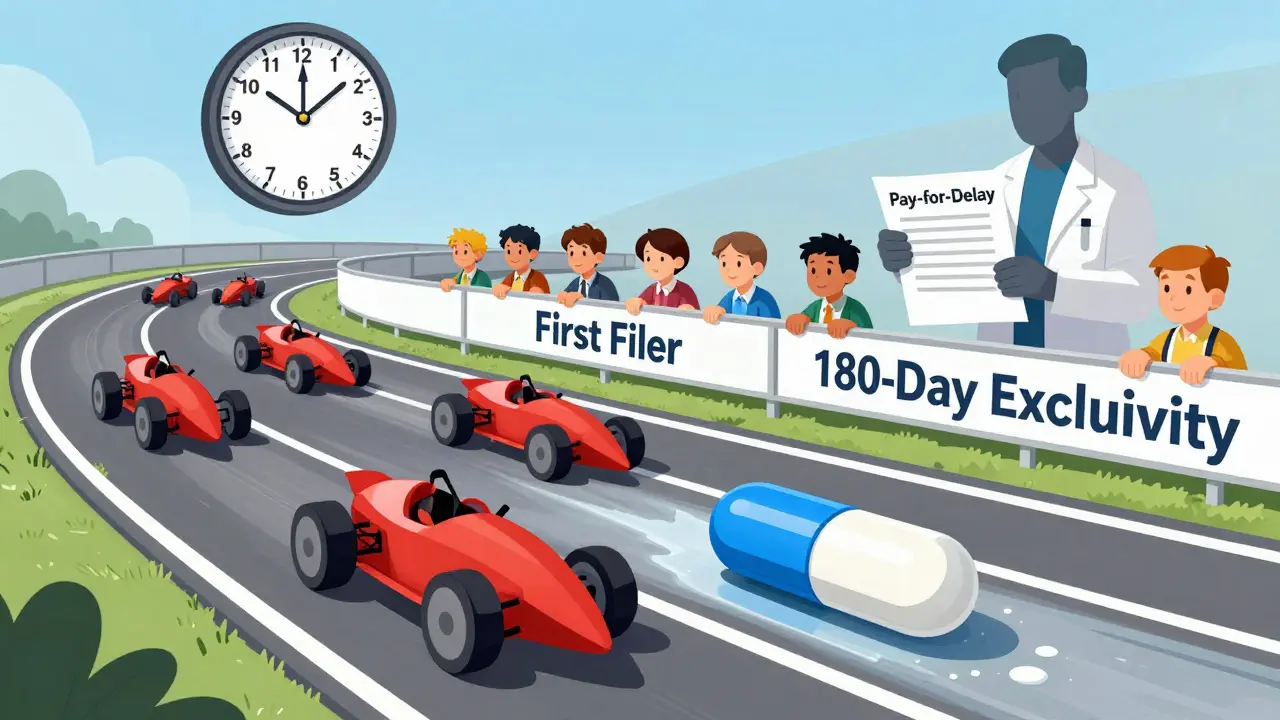
When a brand-name drug’s patent is about to expire, you’d expect generics to flood the market and prices to drop. But that doesn’t always happen - not because there aren’t companies ready to make them, but because of a legal loophole called 180-day exclusivity. This rule, written into U.S. drug law back in 1984, was meant to speed up generic competition. Instead, it’s often used to delay it.
What Is 180-Day Exclusivity?
The 180-day exclusivity rule comes from the Hatch-Waxman Act, a law designed to balance two goals: protecting innovation by drug makers and letting generics enter the market faster. The idea was simple: if a generic company challenges a patent and wins, they get six months of exclusive rights to sell the generic version. No one else can sell the same generic during that time. That’s supposed to reward them for taking the legal risk.
But here’s the catch: the clock doesn’t start when the FDA approves the drug. It starts when the first generic company starts selling it - or when a court rules the patent is invalid or not infringed. And if the company delays selling? The clock doesn’t tick. That means a generic drug can sit on the shelf for years while the company waits for a court decision, and no one else can enter the market.
Take the case of buprenorphine/naloxone sublingual film. The first generic applicant submitted their application in 2016 but didn’t start selling until 2018. During those two years, no other company could launch a competing generic - even though they had their paperwork ready. The FDA later clarified that this delay didn’t forfeit the exclusivity. So the company kept its monopoly, and patients kept paying brand prices.
Who Gets the Exclusivity?
Only the first company to file an ANDA (Abbreviated New Drug Application) with a Paragraph IV certification gets the 180 days. A Paragraph IV certification means they’re saying: "This patent is invalid or we don’t infringe it." It’s a legal challenge. The race to be first is intense. Companies hire teams of lawyers and patent experts just to file one day ahead of their rivals.
What if two companies file on the same day? The FDA has rules to break the tie - usually based on who submitted the most complete application first. But even then, disputes go to court. There have been lawsuits over whether an application was "substantially complete," a term defined in cases like Granutec v. Shalala. One small mistake - a missing form, a mislabeled document - and you lose the exclusivity forever.
And once you get it? You’re the only one who can sell that generic for six months. That’s worth hundreds of millions - sometimes over a billion dollars - for a blockbuster drug. No wonder companies fight tooth and nail to be first.
Why This Rule Backfires
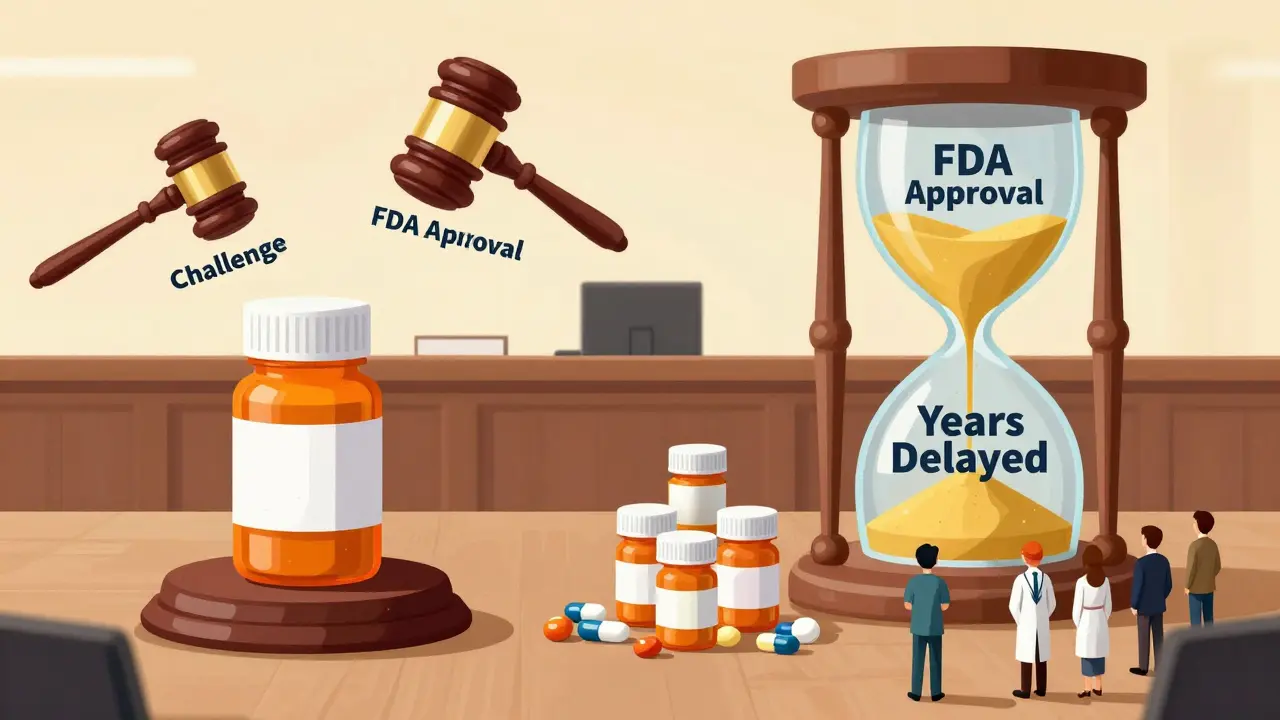
The system was built on the assumption that the first generic would rush to market. But in reality, many companies don’t. Some wait for patent litigation to end. Others sit on exclusivity to avoid competition. A few even strike deals with the brand-name company - agreeing to delay their launch in exchange for cash or other perks. These are called "pay-for-delay" settlements. The FTC has cracked down on them, but they still happen.
Here’s the real problem: the 180-day clock can be paused for years. A drug might have its patent challenged in 2019, but the court case drags on until 2024. The first generic company doesn’t launch until 2025. Now, they get 180 days of exclusivity - but by then, the brand drug’s patent has already expired. That means consumers paid full price for six extra years because the system let one company hold up the market.
Compare that to biosimilars - the generic version of biologic drugs. Under the BPCIA law, the first biosimilar gets 12 months of exclusivity. But unlike the 180-day rule, it doesn’t let the first company delay launch. The clock runs from approval, not from sales. That’s why biosimilar competition kicks in faster.
What the FDA Wants to Change
In March 2022, the FDA proposed major changes. They want the 180-day exclusivity to start the moment the first generic company starts selling - not when a court rules. That means if a company delays, they don’t get to extend their monopoly. The exclusivity would last exactly 180 days from launch.
The proposal also adds a twist: if a company launches more than five years before the patent expires, they’d get 270 days instead of 180. That’s meant to reward early challengers. But it’s also a trap. If they wait too long, they lose the bonus. It’s a gamble.
Another change: if multiple companies file on the same day and all qualify as "first applicants," only one gets the first 90 days. The others get approval on day 91. That’s a big shift from the current "winner-takes-all" system. It’s meant to encourage more competition instead of letting one company sit on exclusivity.
How This Affects Patients and Prices
Generic drugs now make up over 90% of prescriptions filled in the U.S. But they’re not always cheap. Why? Because sometimes, the first generic doesn’t come to market for years after the patent expires. During that time, the brand drug still dominates. Prices stay high. Insurance companies pay more. Patients pay more out of pocket.
One study estimated that the U.S. healthcare system saved $1.7 trillion on generic drugs over the past decade. But that savings could have been bigger - much bigger - if exclusivity wasn’t being used as a delay tactic. For drugs like Adderall, Lipitor, or Crestor, the delay in generic entry cost patients and insurers billions.
And it’s not just about money. When a drug has no generic, patients may skip doses, switch to less effective alternatives, or go without treatment entirely. That’s especially true for chronic conditions like high blood pressure, diabetes, or depression.
What’s Next?
The FDA’s proposed changes are still under review. Congress hasn’t acted yet. Meanwhile, lawsuits keep rolling in. Generic companies are still racing to be first. Brand-name companies are still fighting to extend their patents. And patients? They’re stuck in the middle.
The system was designed to help. But today, it often hurts. Until the rules change, the 180-day exclusivity won’t be a tool for competition - it’ll be a tool for control.
Can a generic company lose its 180-day exclusivity?
Yes. Under the Medicare Modernization Act of 2003, a company can forfeit exclusivity if they don’t market the drug within 75 days of FDA approval, or if they fail to meet other deadlines tied to patent litigation. The FDA clarified in 2018 that even if a company wins the patent challenge, they must start selling within a specific window - otherwise, the exclusivity is gone.
Why doesn’t the FDA approve other generics during the exclusivity period?
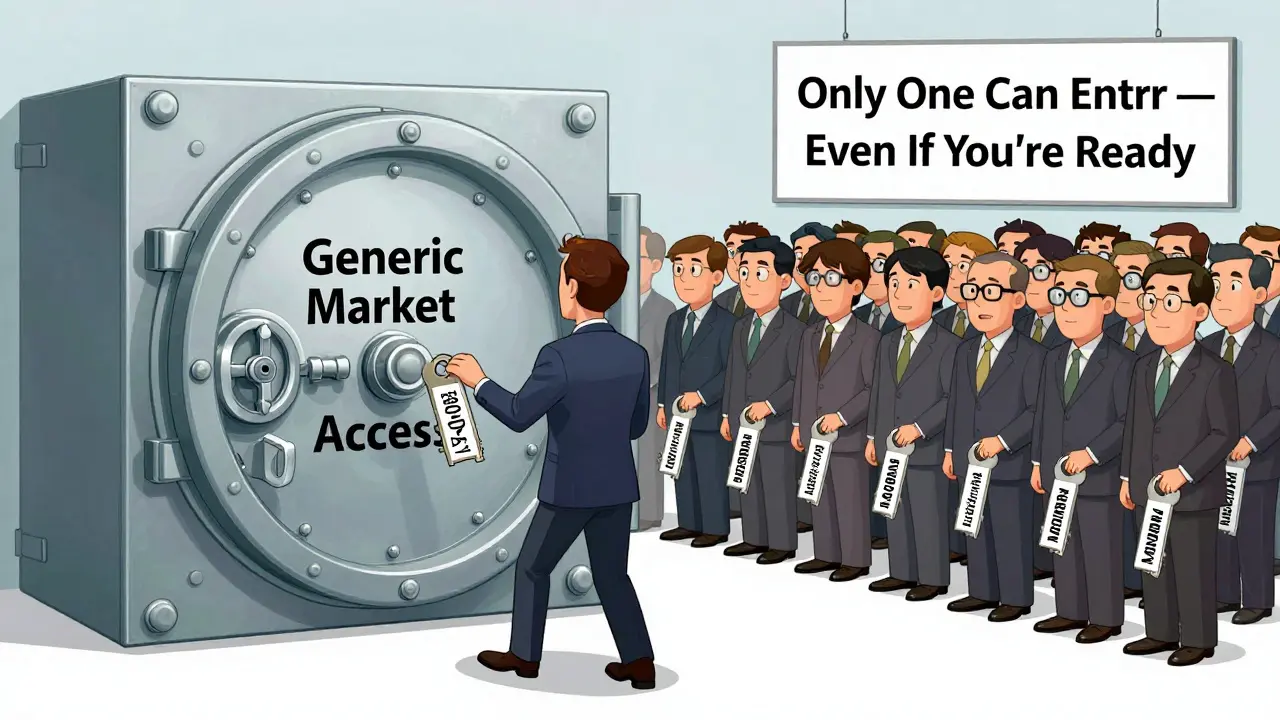
The law blocks approval of any other ANDA that challenges the same patent until the exclusivity period ends. Even if another company’s application is complete and meets all safety standards, the FDA can’t approve it. This is the core of the "winner-takes-all" structure - it’s not about fairness, it’s about legal priority.
Is 180-day exclusivity the same as patent extension?
No. Patent extension lets the brand-name company keep selling their drug longer by adding time to the patent term. 180-day exclusivity doesn’t extend the patent - it blocks other companies from selling the same generic for six months after the patent expires. It’s a market monopoly, not a legal extension of patent rights.
Do other countries have a similar system?
No. The U.S. is one of the only countries with this kind of exclusivity. Canada, the UK, Australia, and the EU don’t give a six-month monopoly to the first generic challenger. They let multiple companies enter at once after the patent expires. That’s why drug prices drop faster in those countries.
What’s the difference between 180-day exclusivity and 5-year new drug exclusivity?
The 5-year exclusivity applies to brand-name drugs with a new active ingredient - it prevents any generic from even applying for approval for five years. The 180-day exclusivity applies only to generics who challenge a patent - and it only kicks in after the patent expires. One blocks entry; the other delays competition after entry is legally allowed.


This is wild. I had no idea the system was this broken. I mean, you’d think after 40 years someone would’ve fixed it. But nah. We just let one company sit on a drug like it’s a monopoly throne. 🤦♂️ Patients pay more, insurers get screwed, and the FDA just watches. The fact that the clock only starts when they *sell*? That’s not a reward-it’s a loophole with a velvet rope.