
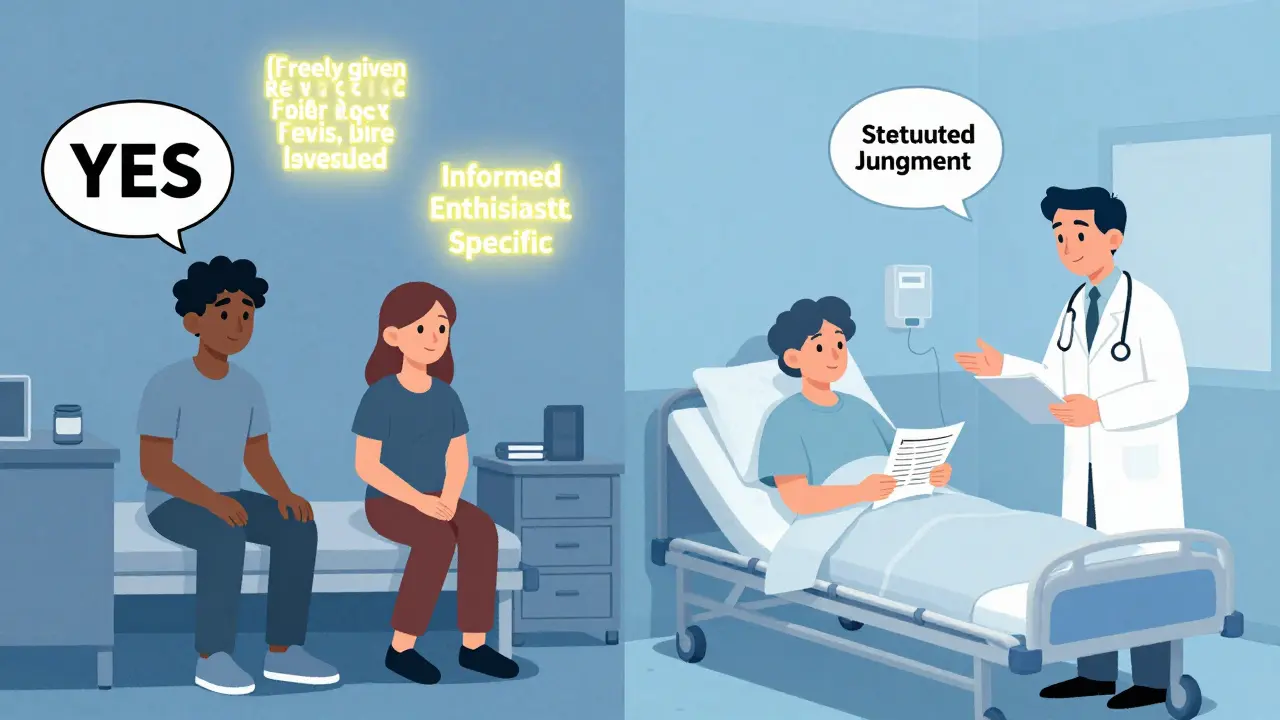
There’s a lot of confusion online about something called affirmative consent laws and how they relate to medical decisions-especially when someone can’t speak for themselves. You might have heard the term in news about campus policies or #MeToo movements, and now you’re wondering: does this apply to doctors making treatment decisions for a patient who’s unconscious or mentally incapacitated? The short answer is no. Affirmative consent laws don’t govern medical substitution. They were never meant to.
What Affirmative Consent Actually Means
Affirmative consent laws are about sex. Not surgery. Not medication. Not end-of-life care. These laws, first passed in California in 2014 and later adopted in 13 other U.S. states, define consent for sexual activity as ongoing, voluntary, and clearly communicated. It’s not enough to say ‘no’-you need an active ‘yes.’ That’s the core idea behind the FRIES model: Freely given, Reversible, Informed, Enthusiastic, and Specific. This standard was created to prevent sexual assault, especially on college campuses. It’s about power, communication, and bodily autonomy in intimate situations.
It has nothing to do with a hospital room.
How Medical Consent Actually Works
When a patient can’t make their own medical decisions-because they’re unconscious, in a coma, or have advanced dementia-doctors don’t rely on affirmative consent. They rely on informed consent and substituted judgment.
Informed consent means the doctor explains the diagnosis, treatment options, risks, benefits, and what happens if nothing is done. The patient (or their legal representative) must understand this and agree. It’s a process, not a single yes-or-no moment.
When the patient can’t give consent, the law steps in. In most U.S. states, including California, decisions are made using the substituted judgment standard. This means the person making the choice-usually a family member or legally appointed guardian-must ask: What would this patient have wanted, if they could speak? They don’t decide what they think is best. They try to step into the patient’s shoes.
For example, if a 70-year-old woman with dementia has a living will saying she never wants a feeding tube, her daughter can’t override that just because she thinks it’s ‘better’ to keep her alive. The law requires the daughter to follow the patient’s known wishes.
Why People Mix These Two Concepts
It’s understandable why the confusion happens. Both involve the word ‘consent.’ Both deal with autonomy. Both are about control over one’s body. But that’s where the similarity ends.
One study at the University of Colorado Denver found that 78% of undergraduate students couldn’t tell the difference between medical consent and affirmative consent standards. Many assumed that if you need a clear ‘yes’ for sex, you must need one for surgery too. That’s not how the law works.
Medical decisions are made under different rules because the stakes and context are completely different. In a sexual encounter, consent must be active and continuous. In a hospital, a patient might be sedated, confused, or too sick to speak. Waiting for a verbal ‘yes’ before giving antibiotics during septic shock would be dangerous-and illegal.
Doctors aren’t supposed to treat patients like potential sexual partners. They’re supposed to treat them like people who need care. The power dynamic in medicine is real, but it’s managed through ethics, training, and legal safeguards-not through sexual consent frameworks.

What Happens When Someone Can’t Consent?
There are clear legal pathways for medical substitution, and they vary slightly by state but follow the same core principles:
- Advance directives: A written document (like a living will or durable power of attorney for healthcare) that tells doctors what you want if you can’t speak.
- Surrogate decision-makers: If no directive exists, next of kin (spouse, adult children, parents) are usually next in line to decide.
- Best interest standard: If no one knows the patient’s wishes, the decision-maker must choose what’s in the patient’s best medical interest-not what’s easiest or cheapest.
- Court-appointed guardians: In complex or contested cases, a judge may appoint someone to make decisions.
In Australia, similar rules apply. The Victorian Medical Treatment Planning and Decisions Act 2016 gives legal weight to advance care plans and appoints medical treatment decision-makers. It doesn’t mention ‘affirmative consent’ once.
Real-World Examples
Let’s say John, 68, has Alzheimer’s and can no longer speak. His wife wants to take him off a ventilator. She knows he once said, ‘I don’t want to be kept alive by machines.’ That’s substituted judgment. She’s not asking for his permission right now-she’s acting on what he told her years ago.
Now imagine a different scenario: Sarah, 22, is at a party. Her date kisses her while she’s passed out. That’s not substituted judgment. That’s assault. The law doesn’t let anyone make decisions for her because she’s unconscious. She didn’t say yes. And under affirmative consent laws, silence is not consent.
Two different laws. Two different outcomes. Same word-‘consent’-but totally different rules.

What Doctors Are Told
The American Medical Association made this crystal clear in 2023: physicians should not apply sexual consent standards to medical decision-making. Doing so creates delays, confusion, and unnecessary legal risk. Medical boards across the country have issued similar guidance.
One 2023 advisory from the Federation of State Medical Boards stated: ‘Informed consent requires understanding and communication-not constant verbal affirmation. Requiring affirmative consent in medical settings would harm patient care and is not supported by law or ethics.’
There’s no state law, no hospital policy, no medical textbook that says a surgeon must get a patient to say ‘yes’ every time they adjust a drip or change a bandage. That’s not how medicine works.
What You Should Do
If you’re worried about who makes decisions for you if you’re ever unable to speak, here’s what matters:
- Write an advance directive. It’s free. You can do it online or with a lawyer. Name someone you trust as your medical decision-maker.
- Talk to your family. Don’t assume they know your wishes. Say it out loud: ‘If I’m in a coma, I don’t want to be hooked up to machines.’
- Keep a copy. Give one to your doctor, your decision-maker, and keep one in your wallet.
- Update it. Your views might change. Revisit it every few years or after a big life event.
You don’t need to understand affirmative consent laws to protect yourself. You just need to understand your own values and make sure someone else knows them.
The Bottom Line
Affirmative consent laws are powerful tools for preventing sexual violence. But they were never designed for hospitals. Trying to force them into medical contexts doesn’t protect patients-it confuses them, delays care, and misrepresents the law.
Medical substitution isn’t about getting a verbal ‘yes’ in the moment. It’s about honoring what someone said, wrote, or lived by when they were able to speak. That’s the real foundation of patient autonomy-not a legal standard meant for bedrooms, not operating rooms.
If you’re preparing for future medical decisions, focus on the right tools: advance directives, clear conversations, and trusted decision-makers. Leave the ‘yes means yes’ rule where it belongs-in the context of sexual relationships, not medical treatment.
