
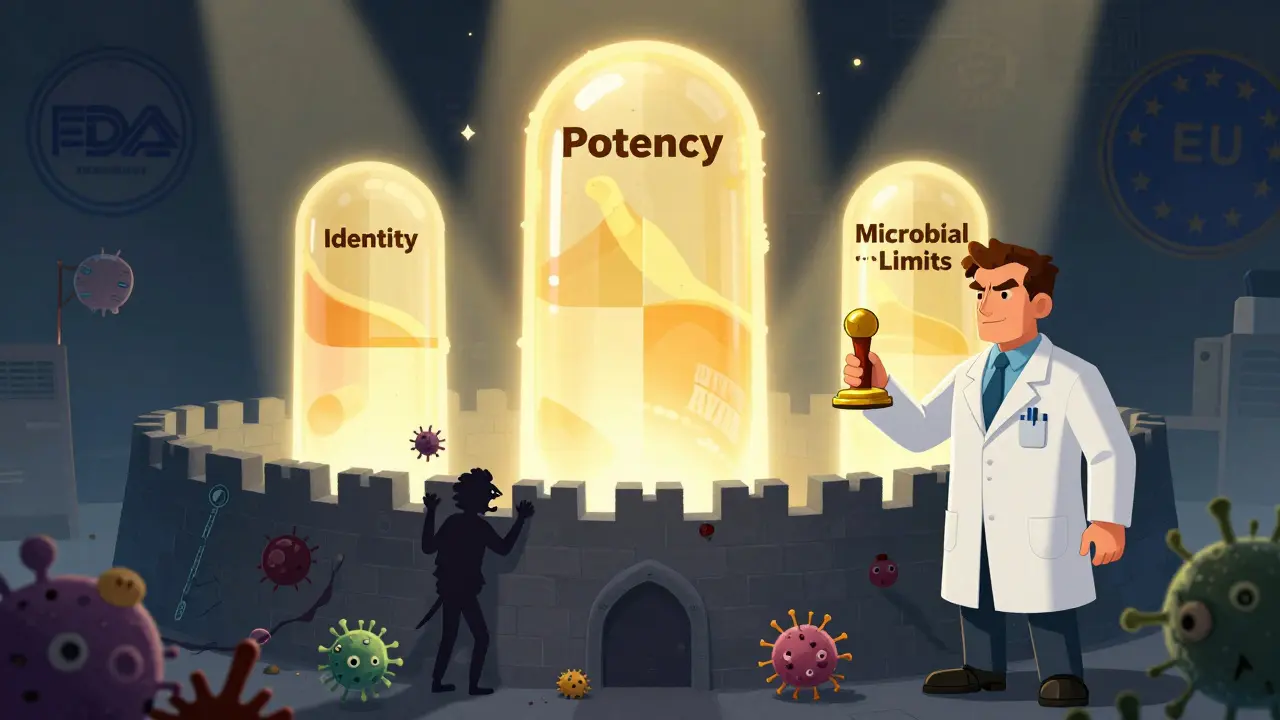
Every pill, injection, or capsule that reaches a pharmacy shelf has passed through one final, non-negotiable gate: batch release testing. This isn’t just paperwork or a formality. It’s the last line of defense between a patient and a potentially dangerous medication. If this step fails, even one batch of contaminated or underpotent drug can trigger a recall, harm lives, and cost millions. In 2023, the FDA reported that the average drug recall costs companies $10.7 million-not counting the damage to trust or reputation. Batch release testing exists to prevent that.
What Exactly Gets Tested?
Batch release testing isn’t a single check. It’s a full suite of lab tests designed to prove that every single batch of medicine matches the exact specifications approved by regulators. These specs are locked in during drug development and tied to the product’s marketing authorization. For a simple tablet, you’re looking at:- Identity: Is this really the drug it claims to be? Tests like HPLC or FTIR confirm the chemical structure.
- Assay/Potency: Does it contain the right amount of active ingredient? Acceptable range is usually 90-110% of the labeled amount.
- Purity: Are there harmful impurities? ICH Q3 guidelines limit unknown impurities to 0.10% in new drug substances.
- Dissolution: Will the tablet break down properly in the body? For generics, the dissolution profile must match the original with an f2 similarity factor of at least 50.
- Physical properties: Tablet hardness (4-10 kp), capsule fill weight, and visual inspection for particulates or discoloration.
- Microbial limits: For non-sterile products, no more than 100 colony-forming units per gram. For injectables, it’s zero tolerance for bacteria or endotoxins.
- Endotoxins: Measured in EU/kg/hr. For spinal injections, the limit is as low as 5.0 EU/kg/hr.
- Particulate matter: For small-volume injectables, no more than 6,000 particles ≥10μm and 600 particles ≥25μm per mL.
Biologics-like monoclonal antibodies or vaccines-add even more complexity. Potency is tested using biological assays (USP <1033> since Jan 1, 2025), and stability is monitored under long-term conditions (25°C/60% RH for up to 36 months) and accelerated conditions (40°C/75% RH for 6 months). Every test method must be validated per ICH Q2(R1). No shortcuts.
The Person Who Signs Off
In the European Union, no batch leaves the facility without a Qualified Person (QP) signing off. This isn’t just any manager. A QP must have at least five years of pharmaceutical experience, specific GMP training, and formal certification. They’re legally responsible for ensuring every batch complies with its marketing authorization. As of 2024, Europe faces a 32% shortage of qualified QPs, creating bottlenecks that delay releases by days or even weeks.In the U.S., there’s no single titled role like the QP, but the requirement is just as strict. A designated quality unit representative must review all test data, manufacturing records, and deviations before release. And it’s not just one person reviewing-it’s two independent analysts verifying the same results under 21 CFR 211.194. That’s double-checking for human error, which still causes 31% of data integrity issues in FDA inspections.
What Happens When It Fails?
Batch failures don’t happen randomly. According to the Parenteral Drug Association’s 2024 report, 83% of rejections come from three areas:- Dissolution testing (32%): The drug doesn’t dissolve at the right rate-meaning it won’t be absorbed properly.
- Impurity profiles (28%): Unexpected chemicals show up, often from raw material changes or process drift.
- Microbial contamination (23%): A single breach in sterile processing can contaminate an entire batch.
One 2023 FDA Form 483 cited a manufacturer that released 12,000 vials of a monoclonal antibody with subpotent batches. The root cause? Inadequate review of stability data. The result: a $9.2 million recall and an 18-month import alert. That’s not just money lost-it’s patients who didn’t get the right dose, and trust shattered.
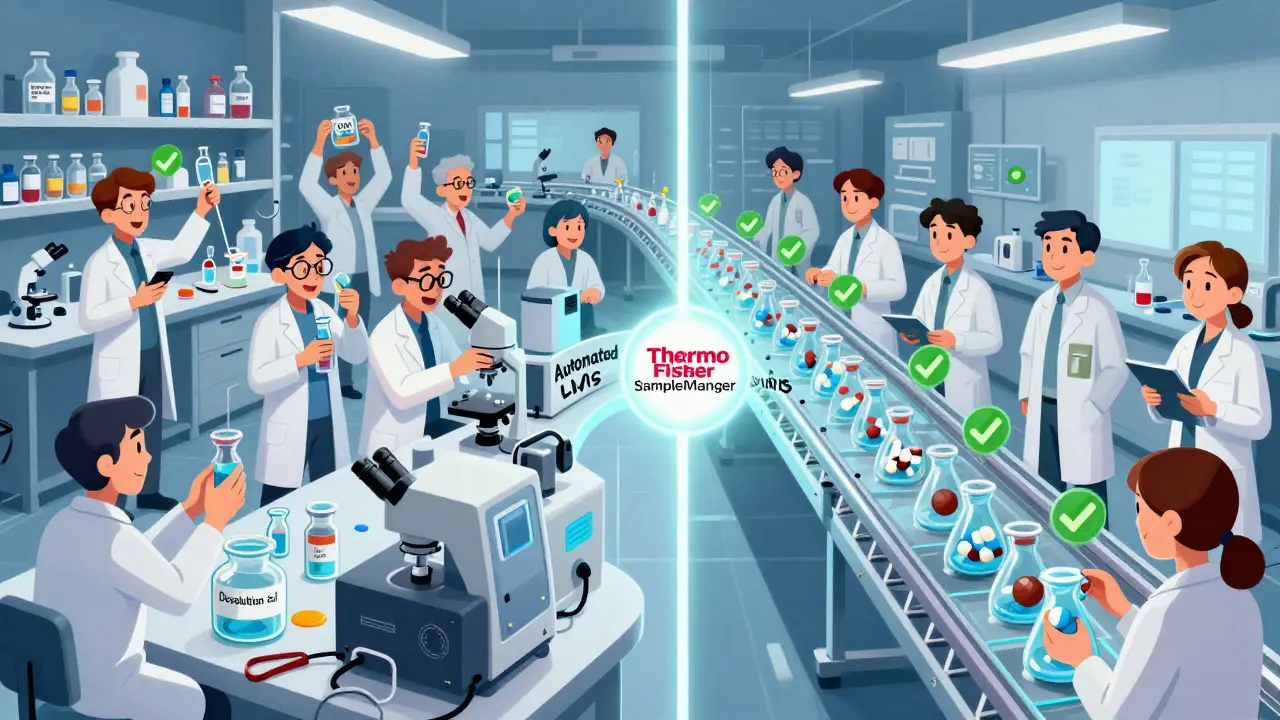
On the flip side, companies using automated review systems have cut human error by 63%, according to a 2024 PDA Journal study. That’s why more firms are investing in digital quality systems and Laboratory Information Management Systems (LIMS). A 2024 AAPS survey found that 65% of labs using LIMS saw a 22% faster release cycle. Thermo Fisher’s SampleManager was cited in 41% of those success stories.
Global Differences and Regulatory Gaps
Regulations aren’t the same everywhere. The EU insists every single batch must be fully tested. The FDA, however, now allows reduced testing for manufacturers with proven continuous manufacturing systems and real-time process controls. This creates headaches for global companies trying to sell the same product in both markets.China’s NMPA started requiring batch release testing for imported vaccines in 2023, adding 14-21 days to the release timeline. Meanwhile, the EMA now requires environmental monitoring data to be reviewed within 72 hours of batch completion-a tight window for labs already stretched thin.
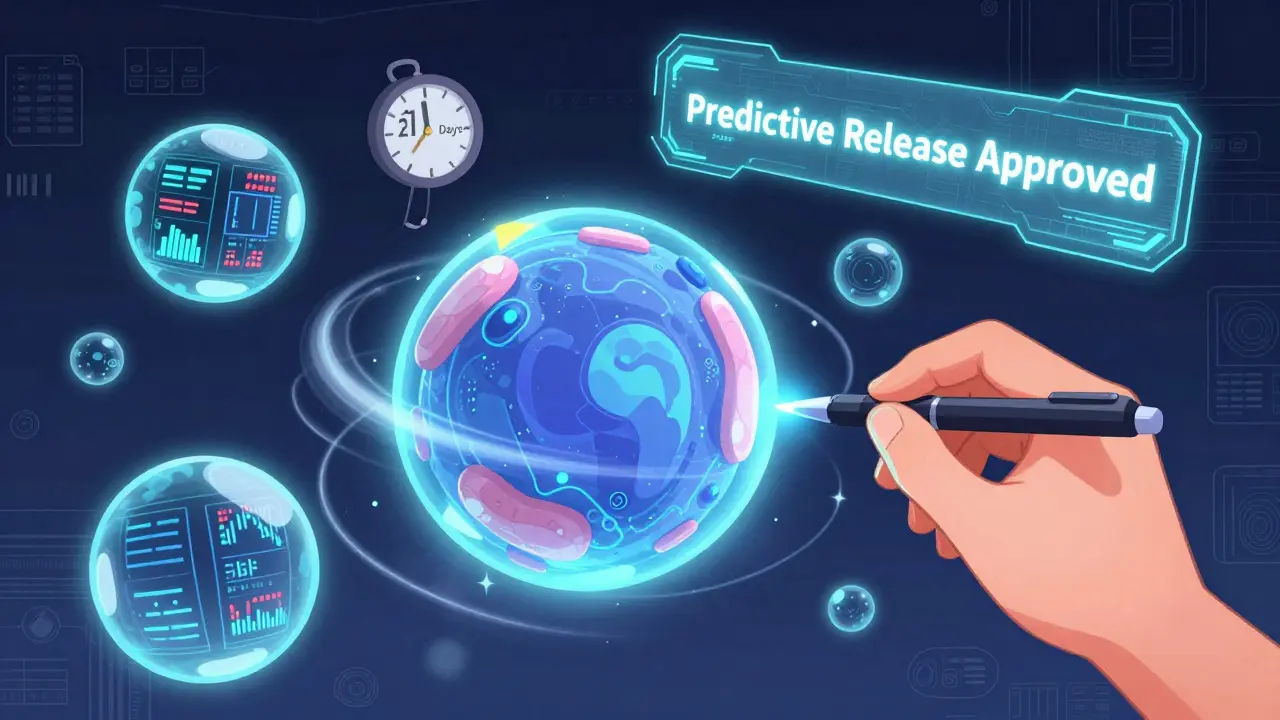
And then there’s the rise of AI. Companies using AI-driven predictive release tools report 34% fewer batch failures. But getting FDA approval for these methods takes 18 months on average. Only 12 companies qualified for the FDA’s 2025 Predictive Release Testing pilot as of October 2025. The EMA’s pilot showed AI matched traditional methods 78% of the time-but regulators want 99.9% confidence before fully trusting it.
How Long Does It Take?
The time it takes to release a batch depends entirely on the product:- Small-molecule generics: 7-10 days
- Complex generics (like inhalers or injectables): 14-21 days
- Biologics (monoclonal antibodies, gene therapies): 21-35 days
Why the gap? Biologics are fragile. Their potency can shift with temperature, pH, or even agitation. Each batch needs stability data, biological assays, and extensive characterization. One senior QP in Melbourne told me she spends 40-60 hours per batch just reviewing documentation for a single biologic product. And that’s before the QP signs off.
Meanwhile, method transfer issues between R&D and manufacturing cause delays in 78% of cases, according to Reddit’s r/Pharmaceuticals community. On average, resolving a failed method transfer takes 14.7 business days. That’s two weeks of product sitting idle, waiting for a lab to confirm it can measure what it’s supposed to.
The Future: Continuous Quality, Not Just Batch Testing
The industry is moving toward continuous manufacturing-where drugs are made in a steady stream, not in discrete batches. This changes everything. The FDA’s 2024 draft guidance says that for these systems, 95% of critical quality attributes must be monitored in real time. That’s the beginning of the end for traditional batch release.But don’t expect it to disappear. ICH Q14 (effective Nov 2024) allows more flexible, risk-based testing for established products. Early adopters cut testing time by 30%. Deloitte predicts 60% of facilities using advanced manufacturing will reduce discrete batch testing by 2030.
Still, 97% of industry experts surveyed by ISPE in February 2025 agree: some form of discrete batch verification will remain necessary through 2040. Why? Because even the most advanced sensors can’t replace the final human judgment that a batch is safe for a sick person to take.
What You Can Do
If you work in pharma quality:- Invest in LIMS and automated review tools-they cut delays and errors.
- Standardize method transfers early. Don’t wait until production to find out your lab can’t replicate the R&D method.
- Train your team on ICH Q6B and Q7 documentation. Missing data points are the #1 reason for regulatory observations.
- Start exploring AI tools for predictive release-but plan for the 18-month validation timeline.
If you’re a patient or caregiver: trust that this system exists. Every pill you take went through this gauntlet. It’s not perfect, but it’s the most rigorously enforced quality control process in any industry. And it’s working. In 2022 alone, batch release testing blocked about 1,200 potentially harmful batches from reaching U.S. patients-up 27% since 2018.
What is batch release testing in pharmaceuticals?
Batch release testing is the final quality control step before a pharmaceutical product is distributed. It involves testing each production batch to confirm it meets predefined standards for identity, strength, purity, potency, and safety. This process is legally required in the U.S., EU, and most major markets and is certified by a Qualified Person (in the EU) or a designated quality unit (in the U.S.).
Who is responsible for approving a batch for release?
In the European Union, a Qualified Person (QP) must certify each batch. The QP must have at least five years of pharmaceutical experience and formal GMP training. In the United States, a designated representative from the quality unit reviews and approves each batch, ensuring all test results and manufacturing records comply with FDA regulations.
What happens if a batch fails release testing?
If a batch fails, it is quarantined and cannot be distributed. The company must investigate the cause-whether it’s a raw material issue, equipment malfunction, or human error. Depending on the severity, the batch may be reprocessed, destroyed, or, in rare cases, released after additional testing and regulatory approval. Failure can lead to recalls, regulatory actions, or even import bans.
How long does batch release testing take?
Testing time varies by product type: small-molecule generics take 7-10 days, complex generics 14-21 days, and biologics 21-35 days. Delays often come from method transfers, documentation reviews, or regulatory requirements like stability data. Automated systems and LIMS can reduce this by up to 22%.
Are there new technologies changing batch release testing?
Yes. AI-driven predictive release tools and real-time process analytical technology (PAT) are being piloted to reduce reliance on end-of-batch testing. The FDA’s 2025 pilot program allows continuous manufacturers to use real-time data for release decisions. However, full regulatory acceptance requires extensive validation, and traditional batch testing remains the standard for most products today.
Why is batch release testing so expensive?
Testing costs have risen 22% since 2020 due to stricter regulations, more complex products (like biologics), and increased testing requirements. Biologics require specialized assays, sterile environments, and longer stability studies. Documentation, validation, and regulatory compliance add significant overhead. Companies with high-volume products see the best ROI on automation and AI tools.


Wow, this is one of the most thorough breakdowns of batch release testing I’ve ever read-seriously, thank you! I work in QA at a mid-sized generics firm, and I can tell you: dissolution failures are the #1 nightmare. One time, we had a batch rejected because the tablet dissolved 2% slower than the reference. We thought it was negligible. The regulator? Not so much. We lost three weeks and $400K. Now we run dissolution tests in triplicate, and we’ve got a dedicated stability chamber just for pre-release checks. It’s brutal, but it works.