
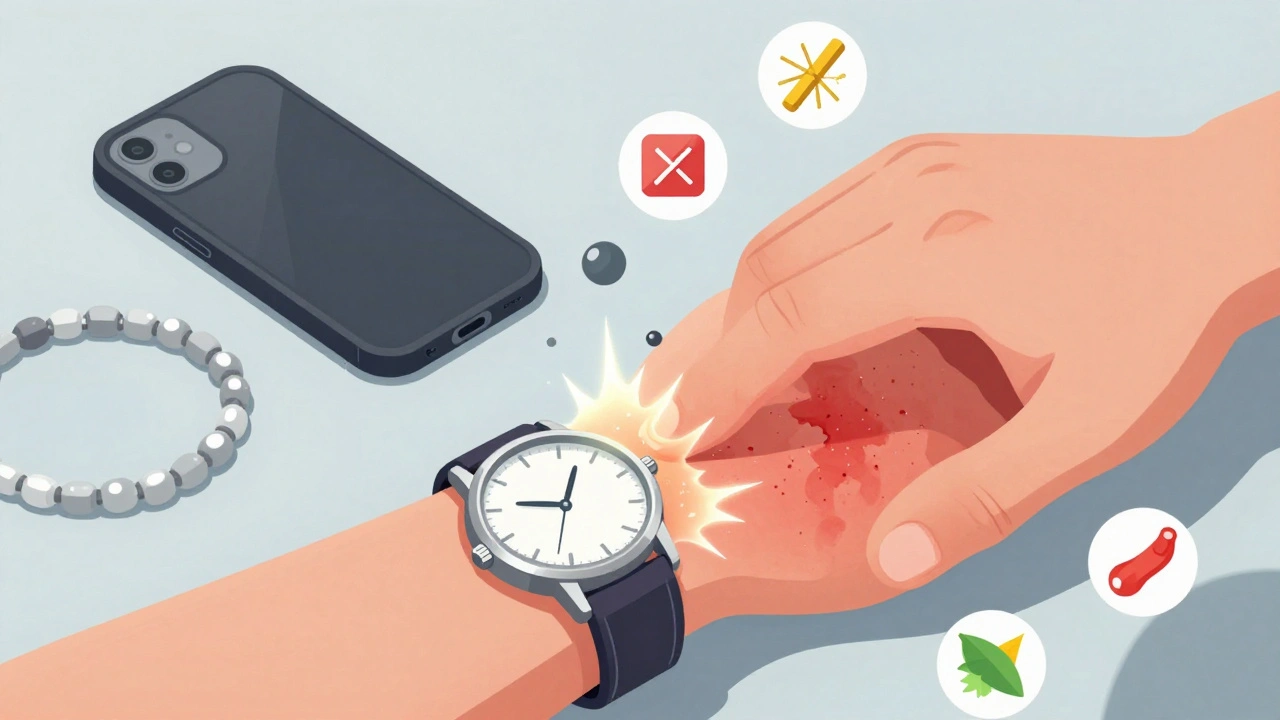
Every time you put on your watch, wash your hands, or apply lotion, your skin could be reacting to something invisible. If you’ve had a stubborn rash that comes back again and again-itchy, red, flaky, sometimes even oozing-you might not have eczema. You might have contact dermatitis, and more specifically, allergic contact dermatitis (ACD). Unlike irritant dermatitis, which is caused by harsh chemicals burning your skin, ACD is an immune response. Your body has learned to see a harmless chemical as a threat, and now it fights back every time you touch it.
How Your Skin Turns Against You
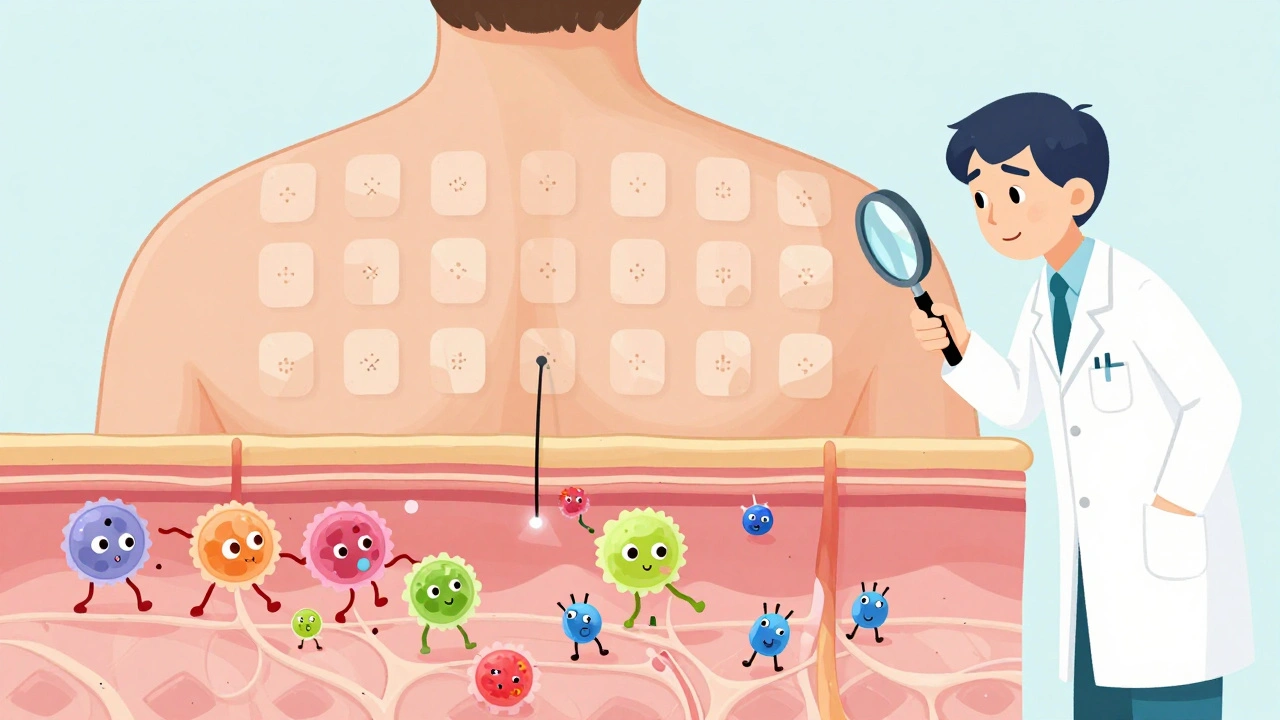
Allergic contact dermatitis isn’t something you’re born with. It develops over time. Think of it like a silent betrayal. A tiny chemical-maybe from your favorite perfume, your earrings, or even your phone case-penetrates your skin. It binds to proteins in your body, and your immune system says, "Wait, this doesn’t belong." Langerhans cells, your skin’s own immune sentinels, pick up this altered protein, travel to your lymph nodes, and recruit T-cells to attack. The next time you touch that same chemical, your skin erupts. This isn’t an instant reaction. It takes 24 to 72 hours. That’s why people often think, "I didn’t do anything different yesterday," and wonder why their rash showed up today.
It’s more common than you think. In the U.S., about 13.7 million workers develop contact dermatitis each year. Hairdressers, nurses, construction workers, and mechanics are at highest risk. But it’s not just jobs. Women are more likely to react to nickel in jewelry, and everyone is exposed to hidden allergens in shampoos, lotions, and even laundry detergents. Nickel alone affects nearly 1 in 7 people tested. And it’s not just metal. Fragrances, preservatives, and plant extracts like poison ivy or balsam of Peru can trigger the same response.
The Gold Standard: Patch Testing
If you’ve been dealing with unexplained rashes for months-or years-it’s time to get patch tested. This isn’t a skin prick test like for pollen or peanuts. Those test for immediate reactions. Patch testing finds the delayed ones, the kind that sneak up on you days later.
The process is simple but precise. Small patches, each containing a different potential allergen, are taped to your back. You wear them for 48 hours-no showering, no sweating. Then you return, and the patches are removed. The doctor checks for redness or swelling. You come back again at 96 hours (four days later) for a final read. That’s because some reactions take longer to show up.
The standard test, called the TRUE Test, checks for 29 common allergens. The most frequent offenders? Nickel sulfate (found in jewelry, belt buckles, zippers), cobalt chloride (in paints, cement, some cosmetics), thimerosal (a preservative in some eye drops and vaccines), and fragrance mix (a blend of 10 common scent chemicals). But here’s the catch: there are thousands of possible allergens out there. The TRUE Test only covers a fraction.
That’s why some patients need expanded testing. If you’re a hairdresser, your dermatologist might test for paraphenylenediamine (PPD), the chemical in hair dye. If you work with epoxy or glue, you might need tests for formaldehyde or acrylates. A 2023 study showed that when doctors use expanded panels with 70 to 100 allergens, they find the cause in nearly 90% of stubborn cases. Without it, you might walk away thinking, "I tested negative," when you just didn’t get tested for the right thing.
What the Test Results Really Mean
Getting a positive result isn’t just a diagnosis-it’s a roadmap. One patient, "EczemaWarrior87," posted on Reddit after five years of rashes: "Patch testing found I was allergic to cocamidopropyl betaine. I stopped using any product with it. My hands cleared up in two weeks." That’s the power of knowing.
But false negatives happen. About one-third of patients need repeat or expanded testing because the first test missed the culprit. Formaldehyde, for example, isn’t always in the standard panel. Some people react to preservatives in their toothpaste or even to chemicals in their own sweat that break down into allergens. That’s why doctors don’t just rely on the test. They ask: "What do you touch every day?" "Do you wear gloves at work?" "Did you change your soap last month?" "Have you started using a new phone case?"
And interpretation matters. A 2023 study found that non-specialists misread patch test results up to 30% of the time. A faint red spot might be irritation, not allergy. A blister might be an infection. That’s why you need a dermatologist trained in contact dermatitis-not just any doctor. The American Contact Dermatitis Society recommends seeing a specialist if your rash doesn’t improve after avoiding obvious irritants.
Avoidance Isn’t Just About Skipping Products
Knowing your allergen is only half the battle. Avoiding it is the other half-and it’s harder than it sounds.
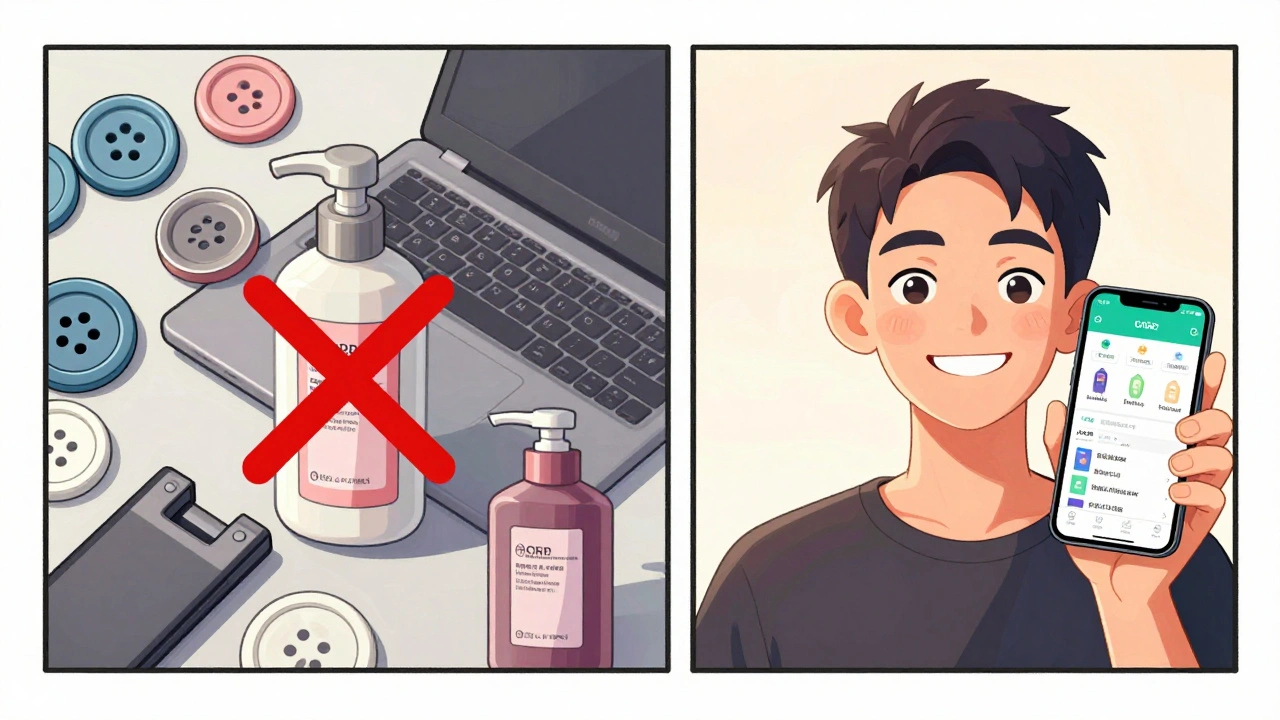
Nickel is everywhere. It’s in your jeans buttons, your laptop hinges, your keys, your eyeglass frames, your kitchen faucet. You can’t avoid all of it. But you can reduce exposure. Use clear nail polish on the back of your watch to create a barrier. Wear leather gloves when handling metal tools. Choose jewelry labeled "nickel-free" or "hypoallergenic"-but be careful. That label isn’t regulated in the U.S., so test it yourself with a nickel spot test kit (available online).
Fragrance is even trickier. It’s in 90% of personal care products. Even "unscented" products can contain masking fragrances to cover up chemical smells. Look for products labeled "fragrance-free," not "unscented." And avoid anything with "parfum," "essential oils," or "natural scent" on the ingredient list. Balsam of Peru, a common hidden allergen, is in everything from tomato sauce to cinnamon gum to hand sanitizer.
That’s where the Contact Allergen Replacement Database (CARD) comes in. Developed by the American Contact Dermatitis Society, CARD lists over 18,000 products that are free of your specific allergens. Want to know which shampoos don’t contain formaldehyde releasers? Or which sunscreens skip oxybenzone? CARD tells you. And it’s updated regularly.
Real Results: What Happens When You Avoid
Patients who follow avoidance advice don’t just feel better-they heal. A 2023 survey of 1,247 people with contact dermatitis found that 82% saw major improvement after avoiding their allergens. Nearly 76% said knowing the exact cause reduced their anxiety. For many, it was the first time they felt in control.
But it takes time. Doctors recommend avoiding the allergen for at least two to four weeks to see if your skin improves. If you’re allergic to cobalt and keep using your new hand cream, you won’t know if it’s working. Stick with it. Even small exposures can keep your skin inflamed.
Workplace exposure is another big one. If you’re a nurse and react to latex or chlorhexidine, your employer should help you switch to alternatives. OSHA guidelines require this. If you’re a mechanic and react to epoxy resin, your gloves might need upgrading. Occupational health specialists can help you find safer tools and materials.
What’s Changing in 2025
There’s new hope on the horizon. The American Contact Dermatitis Society is expanding its patch test panel to 80 allergens by late 2025, adding newer culprits like chemicals in smartwatches, green cosmetics, and 3D-printed materials. In Europe, guinea pig testing for allergens is being phased out by 2027. New blood tests are being studied-like measuring IL-18 levels, which rise with skin inflammation. But for now, patch testing remains the only reliable way to know what’s causing your rash.
And legislation? The EU has strict rules on 26 fragrance allergens in cosmetics. The U.S. doesn’t. The Safe Cosmetics Act has been stuck in Congress since 2021. That means you’re on your own to read labels, research ingredients, and protect your skin.
What to Do Next
If you’ve had a recurring rash for more than a month:
- Stop using new products you’ve added in the last 30 days.
- Switch to plain, fragrance-free soap and moisturizer (like Cetaphil or Vanicream).
- Take photos of your rash and note when it flares up.
- Make a list of everything you touch daily: jewelry, tools, cleaners, makeup, phone, keyboard, etc.
- Ask your doctor for a referral to a dermatologist who does patch testing.
Don’t wait. Every day you keep touching your allergen, your skin gets more sensitive. The longer you wait, the harder it becomes to control.
Can contact dermatitis go away on its own?
It can, if you completely avoid the allergen. But if you keep touching it-even once a week-the rash will keep coming back. The immune system remembers. Without identifying and avoiding the trigger, it’s not a matter of if, but when, the rash returns.
Is patch testing painful?
No. The patches are taped to your back and don’t hurt. You might feel a little itch or tightness, but no needles or pricks. The reaction you see on your skin after removal is the test result-not a side effect. Some people get mild redness or irritation from the adhesive, but that’s not an allergy.
Can I do patch testing at home?
No. Home patch tests are unreliable and dangerous. Applying allergens without medical supervision can cause severe reactions, scarring, or spread the allergy to other areas. Only trained dermatologists should perform and interpret patch tests. Don’t risk it.
What if I’m allergic to nickel but need a metal implant?
Most modern implants are made from titanium or medical-grade stainless steel, which rarely cause reactions. But if you have a known nickel allergy, tell your surgeon. They can request nickel-free implants or do a pre-op patch test on the implant material. Reactions to implants are rare, but they happen-especially with older or low-quality metals.
Are natural products safer for sensitive skin?
Not necessarily. Many natural ingredients are common allergens. Tea tree oil, lavender, chamomile, and even plant extracts like balsam of Peru can trigger contact dermatitis. "Natural" doesn’t mean non-allergenic. In fact, fragrance from essential oils is one of the top causes of allergic reactions in skincare.
How long does it take to see improvement after avoiding an allergen?
Most people notice improvement within 2 to 4 weeks. But full healing can take up to 8 weeks, especially if the skin has been inflamed for a long time. Be patient. Stopping the exposure is the most important step-then give your skin time to repair.


so i got a rash from my phone case n didn't even know it was nickel till i read this. patch test saved my life lol