
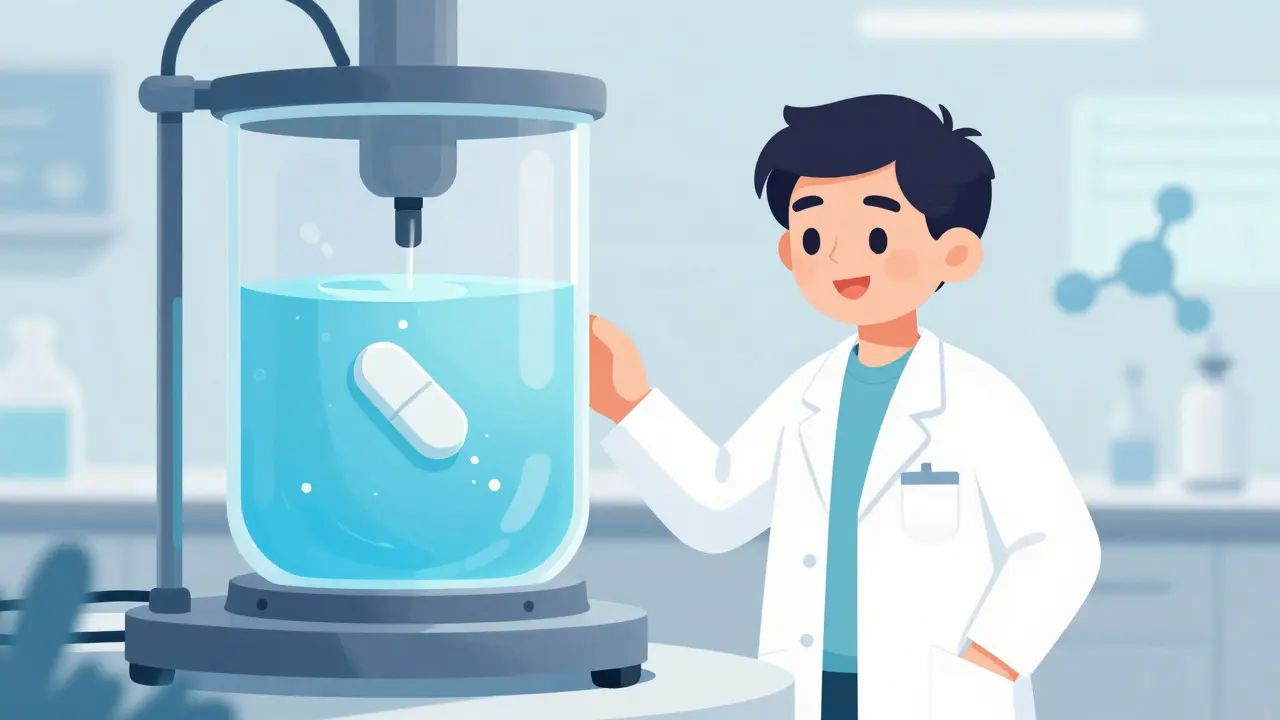
When you pick up a generic version of a prescription medication, you expect it to work exactly like the brand-name original. You trust that the pill will dissolve in your stomach at the right speed, releasing the active ingredient into your bloodstream effectively. But how do regulators actually verify this without testing every single batch on human volunteers? The answer lies in a critical laboratory procedure known as dissolution testing.
This process is the backbone of generic drug approval in the United States. It serves as the primary scientific bridge between a new generic product and its established reference listed drug (RLD). By simulating human digestion in a controlled environment, the U.S. Food and Drug Administration (FDA) ensures therapeutic equivalence before these medications ever reach pharmacy shelves.
The Core Purpose of Dissolution Testing
Dissolution testing measures how quickly a drug product releases its active pharmaceutical ingredient (API) under specific conditions. Think of it as a simulated digestive system. In a lab, specialized equipment rotates the tablet or capsule in a fluid that mimics stomach acid or intestinal fluids. Sensors then measure how much of the drug has dissolved over time.
For generic manufacturers, this test is not just a quality check; it is a regulatory requirement mandated by the Abbreviated New Drug Application (ANDA) process. Unlike New Drug Applications (NDAs) for brand-new molecules, which require years of expensive clinical trials, ANDAs allow generic makers to skip most human studies if they can prove their product is bioequivalent to the RLD. Dissolution data provides the evidence needed to make that claim.
The FDA views this testing as a vital diagnostic tool. It helps evaluate whether changes in manufacturing-such as switching suppliers for raw materials or altering production sites-might negatively impact how the drug performs in the body. If the dissolution profile matches the reference product, regulators assume the in vivo performance will also match.
Technical Standards and Method Requirements
The FDA does not leave dissolution methods to chance. According to guidance documents updated as recently as September 2023, applicants must submit comprehensive data across five specific categories. These requirements ensure that the testing method is robust, valid, and capable of distinguishing between different formulations.
- Solubility characteristics: Detailed analysis of the bulk drug substance's behavior in various solvents.
- Method validation: Proof that the chosen instrument type, rotation speed, and medium composition yield consistent results.
- Robustness verification: Deliberate variations in parameters to ensure the method holds up under minor fluctuations.
- Analytical validity: Confirmation that the technique used to quantify the dissolved drug is accurate and precise.
- Discriminatory ability: Demonstration that the method can detect differences between formulations, especially crucial for sustained-release products.
Most immediate-release oral solid doses use standard apparatuses defined in the United States Pharmacopeia (USP), typically Apparatus 1 (Basket) or Apparatus 2 (Paddle). The FDA often specifies rotation speeds between 50 and 100 rpm and uses buffers with pH levels that mimic the gastrointestinal tract, such as pH 1.2 for stomach acid and pH 6.8 for intestinal fluids. For highly soluble drugs, the agency may require that at least 80% of the drug dissolves within 45 minutes.
Bioequivalence and the f2 Similarity Factor
How does the FDA decide if two dissolution profiles are similar enough? They rely on statistical calculations, primarily the f2 similarity factor. This metric compares the dissolution curves of the generic test product against the reference listed drug.
The f2 value ranges from 0 to 100. A score of 50 or higher indicates that the two profiles are statistically equivalent. If the f2 value falls below 50, the FDA may request additional studies or reject the application, as it suggests the generic might release the drug too slowly or too quickly compared to the brand name. This mathematical approach removes subjectivity from the approval process, ensuring that decisions are based on hard data rather than visual inspection of graphs.
However, statistics alone aren't always enough. For complex products like modified-release formulations, the FDA requires testing under multiple pH conditions. They also conduct alcohol challenge tests, exposing the drug to up to 40% ethanol to check for "dose dumping"-a dangerous scenario where the entire dose is released at once when taken with alcoholic beverages.
The Role of the Biopharmaceutics Classification System (BCS)
Not all drugs require the same level of scrutiny. The FDA utilizes the Biopharmaceutics Classification System (BCS) to categorize drugs based on their solubility and permeability. This system allows for streamlined approvals through biowaivers.
| BCS Class | Characteristics | Regulatory Approach |
|---|---|---|
| Class I | High Solubility, High Permeability | Biowaiver possible; no human bioequivalence study needed if dissolution matches standards. |
| Class II | Low Solubility, High Permeability | Rigorous dissolution testing required; often needs discriminatory methods. |
| Class III | High Solubility, Low Permeability | Emerging biowaiver opportunities under specific conditions. |
| Class IV | Low Solubility, Low Permeability | Complex testing; rarely eligible for biowaivers. |
For BCS Class I drugs, the FDA’s August 2018 guidance permits manufacturers to bypass human bioequivalence studies entirely if they meet strict dissolution criteria. This means a single-point test at 30 minutes using 900 mL of 0.1N HCl can be sufficient. This efficiency gain reduces development timelines significantly, allowing generic versions of common antibiotics or pain relievers to reach the market faster.

Challenges in Method Development
Despite clear guidelines, developing an acceptable dissolution method is not straightforward. Manufacturers often spend six to twelve months refining protocols for complex products. The biggest hurdle is creating a method that accurately simulates the human gastrointestinal tract while remaining sensitive enough to detect formulation flaws.
If a generic manufacturer’s initial dissolution data differs substantially from the reference product, but subsequent human bioequivalence studies show the drugs perform similarly in patients, the FDA may establish unique dissolution specifications for that specific generic product. This flexibility acknowledges that perfect in vitro matching isn't always achievable or necessary, provided patient safety is maintained.
Documentation is another significant burden. Applicants must include extensive reports in Module 3.2.P.5 of their ANDA submissions. These sections can run 50 to 100 pages per product, detailing every step of method development. Regulators scrutinize these documents to ensure the chosen method wasn't manipulated to hide performance issues.
Future Directions and Regulatory Evolution
The landscape of dissolution testing continues to evolve. As of late 2023, the FDA’s Dissolution Methods Database contains recommended methods for over 2,800 drug products. This resource helps standardize testing across the industry, reducing ambiguity for manufacturers.
Looking ahead, the agency is exploring physiologically relevant dissolution testing methods that better mimic real-world digestive conditions. There is also potential expansion of biowaivers to BCS Class III drugs, which could further accelerate generic approvals. Industry analysts predict that by 2025, approximately 35% of generic drug approvals will leverage standardized dissolution methodologies, up from 25% in 2020.
Ultimately, dissolution testing remains a product-specific science. While trends move toward simplification and standardization, the FDA maintains that each drug requires a tailored approach. This balance between efficiency and rigor ensures that when you take a generic medication, you are receiving a product that is scientifically proven to work as intended.
What is dissolution testing in the context of generic drugs?
Dissolution testing is a laboratory procedure that measures how quickly a generic drug releases its active ingredient in a simulated digestive environment. The FDA uses this data to ensure the generic performs equivalently to the brand-name reference listed drug (RLD) without requiring extensive human clinical trials.
How does the FDA determine if a generic drug is bioequivalent?
The FDA primarily uses the f2 similarity factor to compare dissolution profiles. An f2 value of 50 or greater indicates statistical equivalence between the generic and the reference product. For some high-solubility drugs, biowaivers based on the Biopharmaceutics Classification System (BCS) allow approval without human bioequivalence studies.
Why is dissolution testing important for patient safety?
It ensures that the drug releases at the correct rate in the body. If a drug dissolves too slowly, it may not be effective. If it dissolves too quickly, it could cause side effects. For modified-release drugs, it also prevents "dose dumping," where the entire dose is released at once.
What is a biowaiver?
A biowaiver is a regulatory exemption that allows generic manufacturers to skip human bioequivalence studies. It is granted for drugs classified as BCS Class I (high solubility, high permeability) if they meet strict dissolution testing criteria, proving they will behave similarly to the brand-name drug in the body.
Does the FDA test every batch of generic drugs?
No, the FDA relies on manufacturers to perform routine dissolution testing during production. However, the FDA inspects facilities and reviews annual reports. If a manufacturer changes its production process or ingredients, they must submit new dissolution data to prove the changes do not affect drug performance.
What happens if a generic drug fails dissolution testing?
If a batch fails dissolution specifications, it is typically rejected and not released to the market. If an approved product consistently shows issues, the FDA may issue warning letters, mandate recalls, or revoke the drug's approval status depending on the severity of the deviation.
