

After cataract surgery, many people notice something strange: small dots, squiggly lines, or cobweb-like shapes drifting across their vision. It can be alarming-especially when you just had surgery to see better. But here’s the truth: floaters after cataract surgery are incredibly common, and in most cases, they’re harmless.
Why Do Floaters Appear After Cataract Surgery?
Before surgery, your natural lens is cloudy, which blurs your vision and hides a lot of the tiny debris floating inside your eye. That debris? It’s made of collagen fibers and cells in the vitreous gel-the clear, jelly-like substance that fills the back of your eye. These particles have been there for years, but you didn’t notice them because the cataract was blocking the light. When the cloudy lens is replaced with a clear artificial one, suddenly everything becomes sharper. And with that clarity comes visibility. The floaters that were always there? Now you see them clearly. It’s not new debris-it’s old debris finally showing up. About 70% of people notice floaters in the first few days after surgery. A study from the National Institutes of Health found that most of these floaters come from a natural process called posterior vitreous detachment (PVD), where the vitreous gel starts to shrink and pull away from the retina. Cataract surgery can speed this up. In fact, phacoemulsification-the most common cataract technique-increases the chance of PVD by 28% compared to what happens naturally with aging.What Do Normal Floaters Look Like?
Normal floaters after cataract surgery have a few key traits:- They’re small-dots, specks, or thin threads, not large blobs
- They move when your eyes move, with a slight delay, like slow-moving smoke
- They’re most noticeable against bright backgrounds: white walls, clear skies, or computer screens
- They don’t change much day to day
- They tend to fade over time, not grow
When Are Floaters a Warning Sign?
Not all floaters are harmless. While 92% are benign, 8% can signal something serious-like a retinal tear or detachment. The difference isn’t just in how many floaters you see. It’s in how fast they show up, and what else comes with them. Here’s what you need to watch for:- Sudden increase: More than 10 new floaters appearing in minutes or hours
- Flashes of light: Seeing streaks or sparks of light, especially in your peripheral vision, happening more than 2 times per minute
- A shadow or curtain: A dark area that seems to block part of your vision, like a shade being pulled across your eye
- Loss of central vision: Blurriness or distortion in the middle of your sight

What Should You Do If You’re Worried?
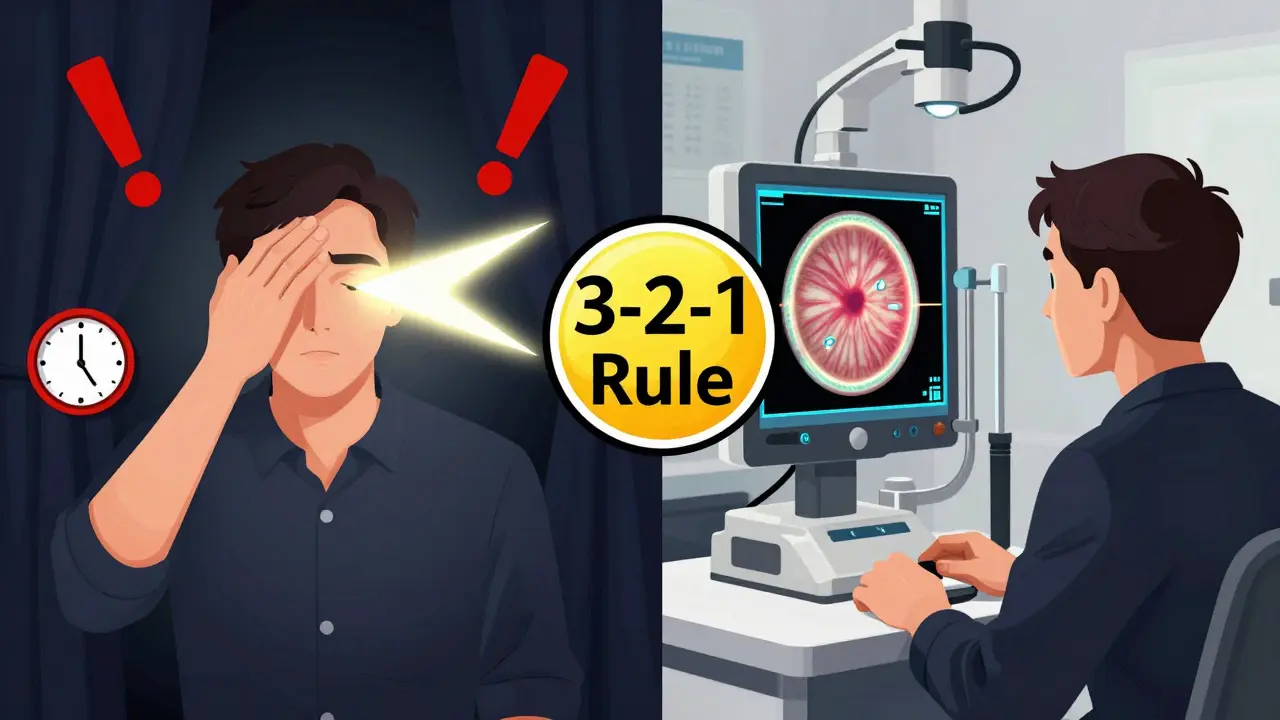
The best thing you can do is know the “3-2-1 Rule.” It’s simple, easy to remember, and used by clinics like West Boca Eye Center to help patients spot danger signs:- 3: More than 3 new floaters per minute
- 2: 2 or more flashes of light per minute
- 1: Any dark shadow or area blocking your vision
How Are Floaters Monitored After Surgery?
Your eye doctor won’t just leave you to figure this out on your own. Standard follow-up care includes dilated eye exams at 1 week, 1 month, and 3 months after surgery. During these visits, they’ll check the retina for tears, check the position of your new lens, and assess whether floaters are stable or worsening. Newer clinics are using optical coherence tomography (OCT)-a non-invasive scan that creates detailed images of the retina-to catch early signs of vitreous pulling or retinal stress. According to Louisiana Retina’s data, using OCT for patients over 60 has cut delayed diagnoses of retinal problems by 32%.Can You Treat or Get Rid of Floaters?
For most people, the answer is: no treatment needed. Your brain learns to ignore them. It’s like tuning out the sound of a ticking clock-you stop noticing it. But if floaters are truly interfering with your daily life-reading, driving, working-there are options:- Eye movements: Gently moving your eyes in circles can shift floaters out of your central vision. About 76% of patients find this helps temporarily.
- Laser vitreolysis: A focused laser breaks up large floaters. It’s effective in 65% of cases, but not everyone is a candidate. It’s not FDA-approved for all types of floaters.
- Vitrectomy: Surgery to remove the vitreous gel and replace it with a clear fluid. It’s 90% successful at removing floaters, but carries risks like infection, cataract progression, or retinal detachment. Only considered if floaters are severely disabling.


I had floaters after my cataract surgery and thought I was going blind
Turns out my brain just needed time to ignore them
Now I forget they're even there