
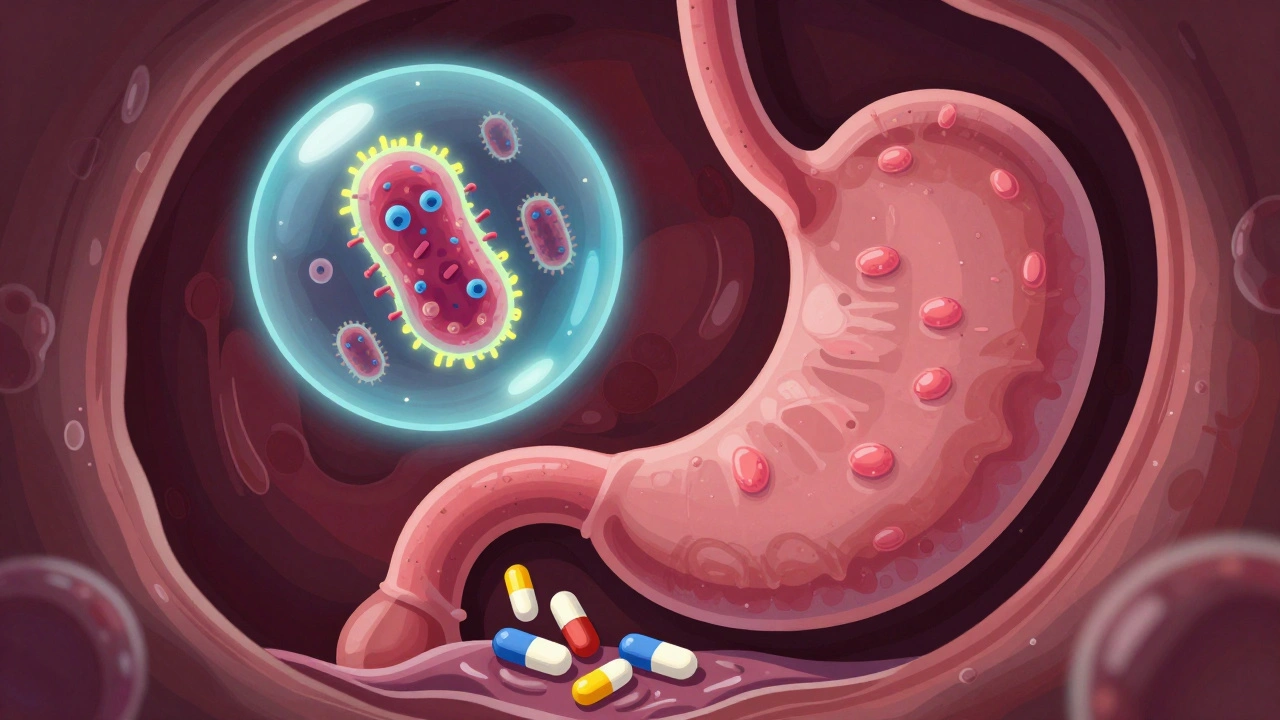
More than half the world’s population carries H. pylori in their stomach - and most don’t even know it. This tiny, spiral-shaped bacterium doesn’t cause symptoms in many people, but for others, it’s the hidden cause of chronic stomach pain, ulcers, and even stomach cancer. What makes H. pylori so tricky is that it survives in one of the harshest environments in the human body: your acidic stomach. It does this by producing urease, an enzyme that turns urea into ammonia, effectively creating a protective bubble of alkalinity around itself. The real danger isn’t just the infection - it’s that treatments are failing more often than ever because of rising antibiotic resistance.
How Do You Know If You Have H. pylori?
Testing for H. pylori isn’t one-size-fits-all. The right test depends on your symptoms, your medical history, and where you live. There are two main categories: non-invasive tests you can do without an endoscope, and invasive tests that require a scope.
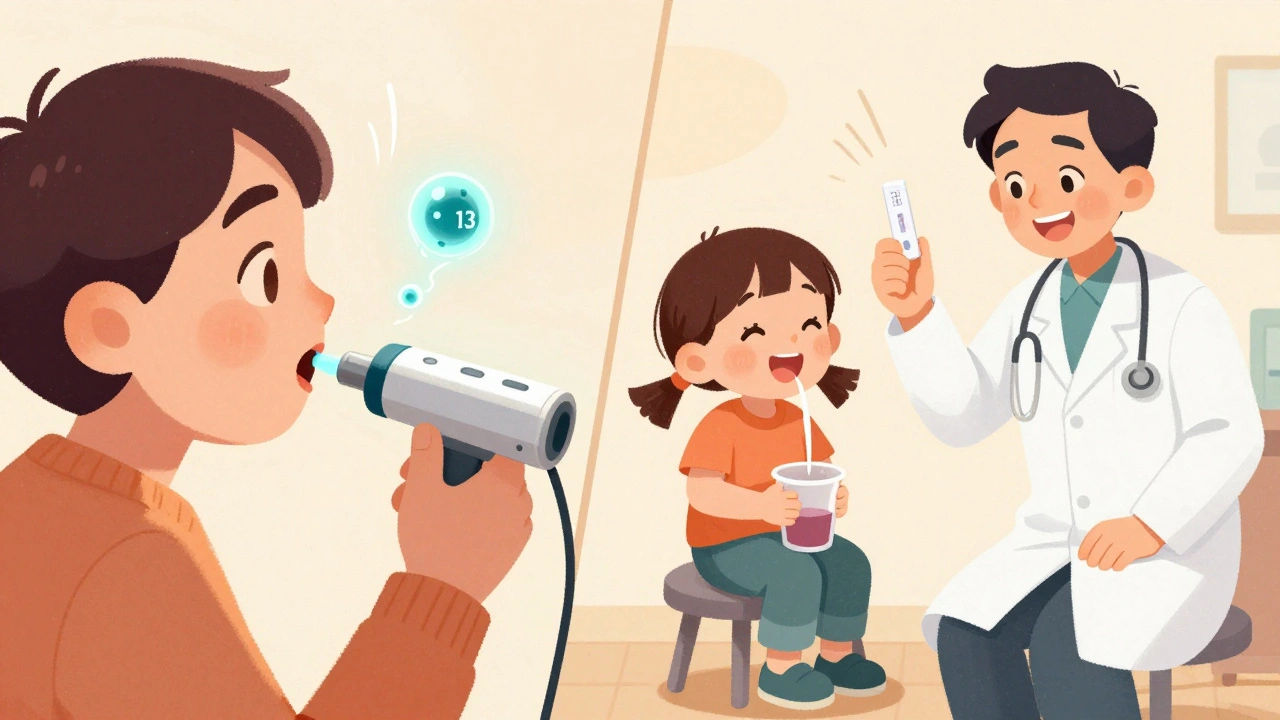
The urea breath test (UBT) is considered the gold standard for detecting active infection. You drink a solution containing urea labeled with carbon-13 or carbon-14. If H. pylori is present, it breaks down the urea, and the labeled carbon shows up in your breath. The test is 95-98% accurate. But here’s the catch: you have to stop proton pump inhibitors (PPIs) like omeprazole or esomeprazole for at least 14 days before the test. Many patients don’t realize this, and when they skip the prep, they get false negatives. One patient on a GI forum said, “I had to go two weeks without my Nexium - my heartburn was unbearable.”
Another popular option is the stool antigen test (SAT). It looks for H. pylori proteins in your poop. It’s just as accurate as the breath test - 93-95% - and doesn’t require stopping your acid meds. That’s why many doctors prefer it, especially for kids. The American Academy of Pediatrics recommends SAT over breath tests for children because it avoids radiation exposure from carbon-14. Parents on support groups say it’s way easier than forcing a child to swallow a sour-tasting liquid and hold their breath.
Then there’s serology, a blood test that checks for antibodies. It’s cheap and easy, but it can’t tell if you have an active infection or if you had one years ago. Antibodies stick around long after the bacteria are gone. So if you’ve been treated before, this test will still say “positive.” That’s why it’s not recommended for diagnosing current infection in places like the U.S., where H. pylori prevalence is low. It’s better for screening in high-risk populations or when you’re checking for past exposure.
If you’re having an endoscopy anyway - say, because you’re bleeding or losing weight - doctors can take tissue samples. The rapid urease test (like CLOtest) gives results in under an hour and is highly specific. But it can miss the infection if you’ve taken antibiotics or PPIs recently. Biopsies can also be sent for culture or PCR testing. Culture is the only way to know exactly which antibiotics the bacteria are resistant to, but it takes days to grow and isn’t available everywhere.
Why Quadruple Therapy Is Now the First-Line Treatment
Twenty years ago, H. pylori was easy to kill. The standard treatment was triple therapy: a proton pump inhibitor plus two antibiotics - usually clarithromycin and amoxicillin. Eradication rates were over 90%. Today? In many places, it’s below 70%. Why? Clarithromycin resistance. In the U.S. and Europe, more than 15% of H. pylori strains are now resistant to clarithromycin. In some cities, it’s over 40%. That means nearly half the time, triple therapy fails.
That’s why guidelines from the American College of Gastroenterology and the European Helicobacter Study Group now recommend bismuth quadruple therapy as the first-line option in most regions. It includes four drugs: a proton pump inhibitor, bismuth subsalicylate (like Pepto-Bismol), tetracycline, and metronidazole. You take it for 10 to 14 days.
Why does this work better? Because it uses antibiotics that are still effective in most cases. Tetracycline and metronidazole resistance is still relatively low - under 10% in most areas. Bismuth itself has antibacterial properties and helps protect the stomach lining. Studies show quadruple therapy achieves eradication rates of 85-90%, even where clarithromycin resistance is high.
There’s also a newer version called concomitant therapy - same four drugs, but taken all at once instead of in sequence. Some doctors prefer this because it’s simpler for patients to follow. Another option is levofloxacin-based triple therapy, but resistance to levofloxacin is rising too - now over 15% in many Western countries - so it’s not ideal as a first choice.
Resistance Is the Real Enemy
The biggest threat to H. pylori treatment isn’t the bacteria itself - it’s our overuse of antibiotics. Clarithromycin is used for everything from sinus infections to pneumonia. Every time someone takes it, they increase the chance H. pylori will evolve to resist it.
Now, we’re seeing resistance to other drugs too. Metronidazole resistance is common in developing countries, and levofloxacin resistance is climbing fast. Even newer drugs like vonoprazan - a potassium-competitive acid blocker approved in the U.S. in 2023 - are being studied for their ability to boost eradication rates by creating a higher, longer-lasting stomach pH. That helps antibiotics work better. Early data shows vonoprazan-based regimens can push success rates above 90%, even in resistant cases.
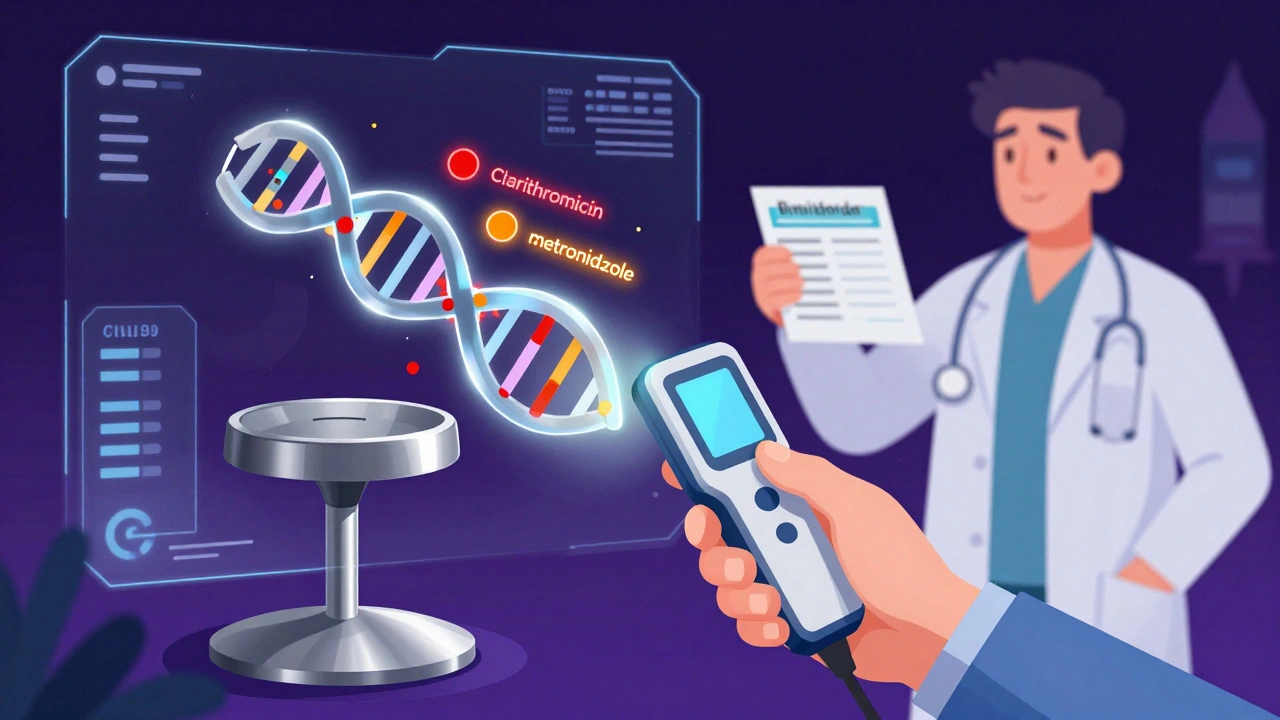
But the future of treatment isn’t just about new drugs - it’s about knowing which ones to use before you start. That’s where molecular resistance testing comes in. In January 2024, the FDA approved the GeneXpert H. pylori test, which can detect the bacterium and its clarithromycin resistance mutations directly from a biopsy sample - in under 90 minutes. Right now, it’s only available at about 150 U.S. medical centers and costs $250 per test. But it’s a game-changer. One study showed that when doctors used this test to guide treatment, eradication jumped from 75% to 92%.
The next big step? Stool-based resistance testing. A clinical trial is currently testing a PCR panel that can detect resistance genes in your poop - no endoscopy needed. If it works, we could soon have a simple, non-invasive way to pick the right antibiotics before you even start treatment.
What Happens If Treatment Fails?
If your first round of therapy doesn’t work, don’t just try the same drugs again. That’s a recipe for more resistance. Instead, you need a different combination - and ideally, one guided by resistance data.
Second-line options include:
- Levofloxacin-based triple therapy (if resistance is low in your area)
- Rifabutin-based therapy (used sparingly because it’s expensive and can affect bone marrow)
- High-dose dual therapy: a very high dose of a PPI plus amoxicillin, taken twice daily for 14 days. This works well in places with low amoxicillin resistance.
Some doctors are also experimenting with sequential therapy - taking different antibiotics in phases - but evidence doesn’t show it’s better than quadruple therapy. The key is avoiding repeat use of antibiotics you’ve already failed on.
What Should You Do If You Suspect H. pylori?
If you have ongoing stomach pain, bloating, nausea, or unexplained weight loss, talk to your doctor. Don’t assume it’s just “acid reflux.” Get tested properly. If you’re on long-term PPIs, ask if H. pylori could be the real issue. Many people take acid meds for years without ever being tested.
Here’s what to ask for:
- If you haven’t taken antibiotics or PPIs in the last 4-14 weeks: get a urea breath test or stool antigen test.
- If you’re a child or can’t stop your acid meds: choose the stool antigen test.
- If you’ve had treatment before and it failed: ask for resistance testing - either via biopsy or, if available, stool PCR.
- If you’re in a high-prevalence area or have a family history of stomach cancer: consider testing even if you have no symptoms.
And if you’re prescribed quadruple therapy? Stick to the full course. Even if you feel better after five days, finish all 10-14 days. Stopping early is one of the biggest reasons treatment fails.
Is There a Future Without Antibiotics?
Scientists are exploring alternatives: probiotics to crowd out H. pylori, vaccines (still in trials), and even bacteriophages - viruses that target bacteria. But none are ready for prime time yet. For now, the best strategy is smarter use of antibiotics: test first, tailor treatment, avoid unnecessary prescriptions, and use resistance-guided therapy whenever possible.
The bottom line: H. pylori isn’t going away. But with better testing and smarter treatment, we can stop it before it causes ulcers, bleeding, or cancer. The tools are here - we just need to use them right.
Can you test for H. pylori without an endoscopy?
Yes. The urea breath test and stool antigen test are both non-invasive and highly accurate for detecting active infection. The breath test requires stopping acid medications for 14 days, while the stool test does not. Both are preferred over blood tests for diagnosing current infection.
Why is quadruple therapy used instead of triple therapy now?
Because clarithromycin resistance has risen above 15% in most developed countries, triple therapy now fails in up to 30-50% of cases. Quadruple therapy uses antibiotics that are still effective - tetracycline and metronidazole - along with bismuth, which helps kill the bacteria and protects the stomach lining. Success rates are 85-90%, compared to 60-75% for triple therapy in resistant areas.
Can H. pylori come back after treatment?
It’s rare for H. pylori to return after successful eradication in developed countries - less than 5% per year. Most recurrences are due to incomplete treatment, not reinfection. In high-prevalence areas, reinfection is more common, especially in crowded households or areas with poor sanitation. Testing after treatment (usually 4 weeks later) confirms the infection is gone.
Does H. pylori cause cancer?
Yes. Long-term H. pylori infection is the strongest known risk factor for gastric (stomach) cancer. It causes chronic inflammation that can lead to changes in the stomach lining, increasing cancer risk over decades. Eradicating H. pylori reduces this risk - especially if done before precancerous changes develop.
What should you avoid before an H. pylori test?
For a urea breath test, avoid proton pump inhibitors (like omeprazole) for 14 days and antibiotics or bismuth (like Pepto-Bismol) for 4 weeks. For stool antigen tests, no preparation is needed. Blood tests don’t require any prep, but they can’t tell if the infection is current.


man i just found out my dad had this and never knew it till he got ulcers. they gave him the stool test and boom. no endoscopy, no pain. just poop in a cup and done. why do docs even make it complicated?