
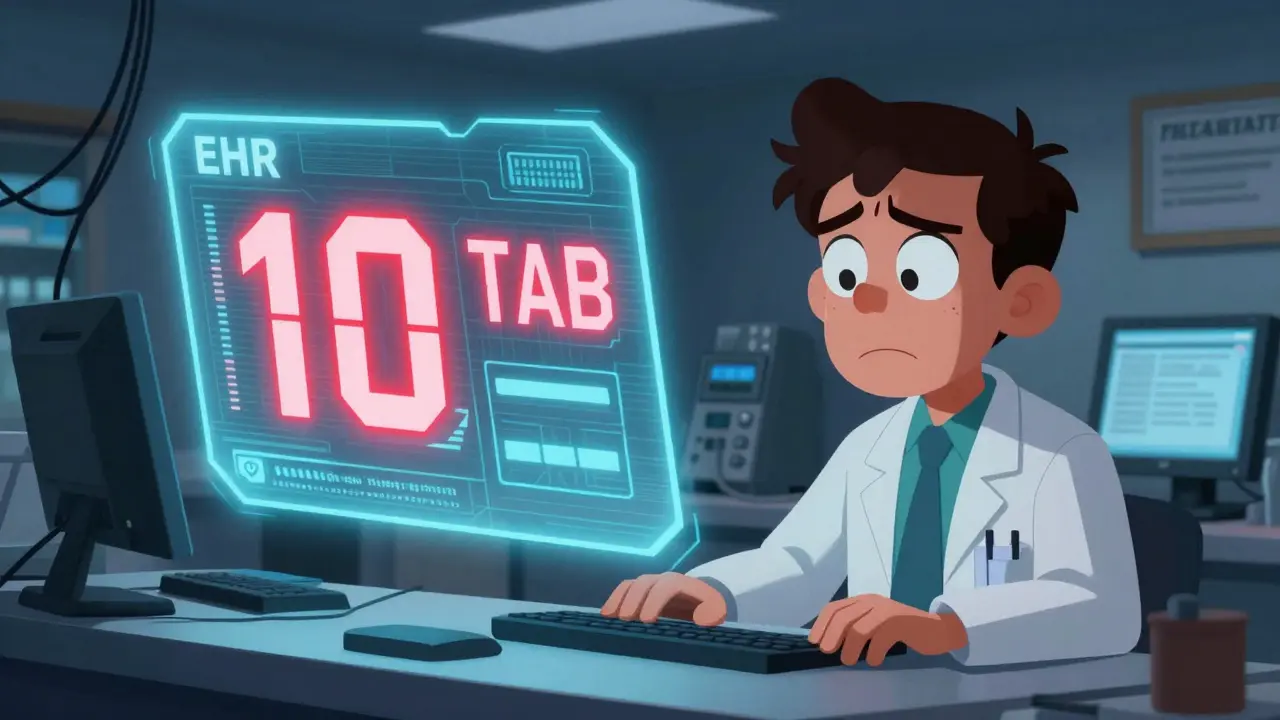
Imagine this: a doctor sends an electronic prescription for a common painkiller. The system works perfectly-the data travels digitally from the clinic to the pharmacy. No handwriting, no ambiguity. But when the pharmacist opens the order, the dosage reads "10 tablets" instead of "1 tablet." One missing space changed a safe dose into a dangerous overdose. This isn't a glitch in the matrix; it is a transcription error within an e-prescribing system.
We adopted electronic prescribing (e-prescribing) to fix the chaos of illegible handwriting. Back in 2006, the Institute of Medicine reported that handwriting caused about 25% of all medication errors. So, we digitized. By 2013, 74% of U.S. office-based physicians were using e-prescribing. It worked-overall prescribing errors dropped by 13% to 99%. But we traded one set of problems for another. While we eliminated scribbles, we introduced new types of mistakes. Today, transcription errors make up roughly 37% to 41.5% of all identified prescribing errors in digital systems. These aren't just typos; they are systemic failures in how different software talks to each other.
Why Digital Prescriptions Still Make Mistakes
You might wonder: if everything is digital, why do errors happen? The problem isn't usually the act of typing. It is the gap between systems. When a doctor uses one Electronic Health Record (EHR) system, like Epic or Cerner, and the pharmacy uses a different management system, like QS/1 or Pioneer, the two programs have to translate data back and forth. If the translation fails, human beings have to step in and re-type information. That manual re-entry is where transcription errors creep in.
Think of it like sending a document via email but forcing the receiver to print it out, photocopy it, and type it into a new computer because their software doesn't accept PDFs. That extra step invites mistakes. A 2017 case study by ISMP Canada showed that seamless data exchange standards could eliminate 92% of these manual re-entry errors. Until those standards are universal, we are stuck with fragmented systems that force pharmacists and technicians to clarify orders constantly. In fact, 41% of pharmacists spend 15 to 30 minutes every single day just fixing these digital glitches.
The Hidden Dangers of 'Sig' Formatting
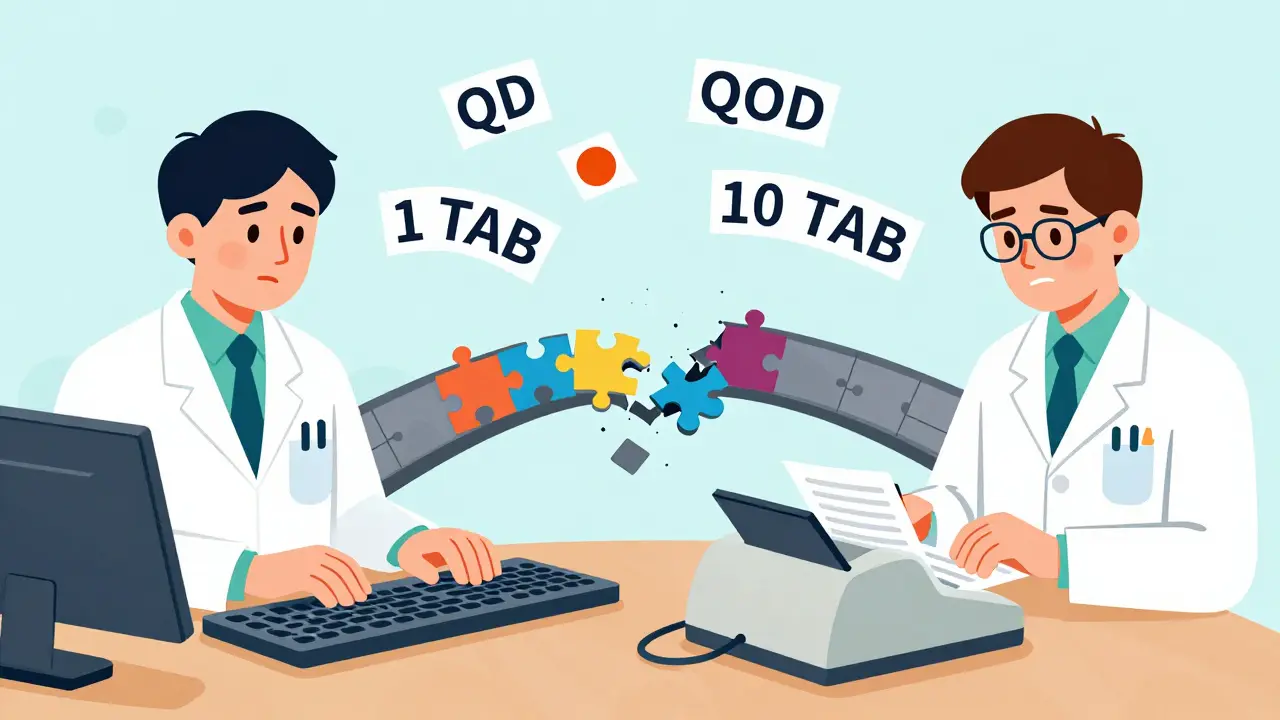
One of the biggest culprits in e-prescribing errors is the "sig"-the instructions on how to take the medication. In handwritten notes, a doctor might write "Take 1 tab daily." In many older e-prescribing setups, this gets converted into shorthand codes like "1 TAB PO DAILY." Here is where it gets risky. Some pharmacy systems misread "1 TAB" as "10 TAB" if the spacing is off or if the font-dependent. Or they might confuse "QD" (every day) with "QOD" (every other day).
A top-rated discussion on Pharmacy Technician's Forum highlighted this exact issue. A pharmacist noted that when prescriptions moved from Epic to QS/1, 27% displayed incorrectly formatted sigs requiring manual correction. The most common error? "Take 1 tablet by mouth daily" becoming "10 TAB PO DAILY." That is a tenfold overdose waiting to happen. Research published in Health Affairs in 2018 found that standardizing these structured sig formats could reduce such errors by 28%. The fix isn't magic; it is simply forcing systems to use full words instead of ambiguous abbreviations.
CancelRx: Stopping Duplicate Confusion
Another major source of transcription confusion happens when a doctor changes their mind. Let's say you prescribe Lisinopril for high blood pressure. Five minutes later, you realize the patient is already on a similar drug, so you cancel the first order and send a new one. In a perfect world, the pharmacy sees the cancellation instantly. In reality, both orders often arrive at the pharmacy counter simultaneously. The pharmacist now has two conflicting scripts for the same patient. Do they fill the first one? The second one? Neither?
This is where the CancelRx protocol comes in. Developed by Surescripts in 2012, CancelRx allows doctors to electronically cancel a prescription before it is filled. This specific tool addresses a huge chunk of transcription-related confusion. Studies show that implementing CancelRx can reduce discontinued medication errors by 63%. If your practice does not use CancelRx, you are relying on phone calls and faxes to clear up digital messes-a process that is slow and prone to human error.
Bridging the Gap: Interoperability Standards
To truly avoid transcription errors, we need better communication between software. This is called interoperability. Currently, only 32% of pharmacies achieve true interoperability without any manual re-entry. The rest rely on workarounds. The solution lies in adopting modern standards like HL7 FHIR (Fast Healthcare Interoperability Resources). Released in its latest major update in November 2021, FHIR provides a technical roadmap for how health apps should share data securely and accurately.
Imagine if your bank app could talk directly to your credit card company without you needing to download statements and upload them manually. That is what FHIR aims to do for healthcare. Pilot studies suggest that moving toward FHIR-based prescription exchange could cut errors by nearly 98%. However, adoption takes time. As of 2022, major players like Epic (used by 27% of U.S. hospitals) and Cerner (22%) are leading the charge, but smaller practices often lag behind due to cost and legacy system issues.
| Error Type | Handwritten Prescriptions | E-Prescribing Systems |
|---|---|---|
| Overall Error Rate | 12.3 per 100 prescriptions | 3.8 per 100 prescriptions |
| Mean Harm Score | 4.6 (High) | 2.2 (Low-Moderate) |
| Primary Cause | Illegible handwriting | System interoperability & formatting |
| Transcription Specific Errors | N/A (Manual entry required) | 37-41.5% of total errors |
Practical Steps for Clinics and Pharmacies
If you run a clinic or manage pharmacy workflows, you cannot wait for industry-wide standards to fix themselves. You can take action today. The Agency for Healthcare Research and Quality (AHRQ) recommends a phased approach to reducing these errors. Start with structured sig formatting. Train your staff to always verify that "1 TAB" does not look like "10 TAB" on the receiving end. Next, ensure your system supports CancelRx. Finally, push for a single shared medication list. When doctors and pharmacists look at the same live database, reconciliation errors drop by 52%.
Training is also critical. Providers need about 4.7 hours of training to adapt to new error-resolution protocols, while pharmacists need around 3.2 hours. It sounds like a lot, but consider the alternative: spending 30 minutes a day fixing preventable mistakes. Also, watch out for "alert fatigue." Dr. Joan Ash, a professor at Oregon Health & Science University, testified that poorly designed clinical alerts contribute to 34% of transcription errors because providers start ignoring warnings. Customize your alerts so they only pop up for critical issues, not every minor interaction.
The Future: AI and Better Connectivity
The good news is that technology is catching up. The market for e-prescribing is growing at 14.7% annually, driven partly by regulations like the 21st Century Cures Act, which penalizes systems that block data sharing. We are seeing new tools emerge, like AI-powered prescription validation. Epic's DoseMeRx, currently in pilot phases, uses artificial intelligence to double-check dosages against patient history. Early projections suggest these AI tools could reduce remaining transcription errors by an additional 65% by 2026.
However, the biggest shift will come from API-based connectivity mandated by the Office of the National Coordinator for Health Information Technology (ONC). By 2025, the goal is widespread API adoption, allowing small practices to connect seamlessly with major pharmacy networks. Until then, vigilance is key. Always verify the sig. Use CancelRx. And never assume that because a prescription arrived electronically, it is error-free.
What is a transcription error in e-prescribing?
A transcription error in e-prescribing occurs when prescription data is inaccurately transferred between healthcare systems or manually re-entered despite digital capabilities. Common causes include incompatible software formatting, ambiguous abbreviation interpretations (like '1 TAB' vs '10 TAB'), and lack of real-time cancellation protocols.
How does CancelRx help prevent errors?
CancelRx is a protocol that allows prescribers to electronically cancel a prescription before it is filled. This prevents confusion when multiple versions of a script arrive at the pharmacy simultaneously, reducing discontinued medication errors by up to 63%.
Why are 'sig' instructions a common source of errors?
Sig instructions (how to take the medication) often use abbreviations that vary between systems. For example, 'PO' means by mouth, but spacing issues can cause '1 TAB PO' to be read as '10 TAB PO'. Standardizing these formats into full words significantly reduces misinterpretation.
What is HL7 FHIR and why does it matter?
HL7 FHIR (Fast Healthcare Interoperability Resources) is a technical standard that enables different healthcare software systems to exchange data seamlessly. Adopting FHIR can eliminate up to 92% of manual re-entry errors by ensuring data translates correctly between EHRs and pharmacy systems.
Can AI help reduce e-prescribing errors?
Yes. Emerging AI tools like Epic's DoseMeRx analyze prescriptions against patient history to flag potential dosing errors. Projections indicate these tools could reduce remaining transcription errors by an additional 65% by 2026, acting as a final safety net before dispensing.
