
Brand-name drugs can cost hundreds of dollars a month-even with insurance. If you’re paying $400 or more for your medication every cycle, you’re not alone. But there’s a way many people slash those costs down to $50 or less: manufacturer savings programs. These aren’t charity. They’re tools built by drug companies to help you afford their brand-name pills, while keeping you on them longer. And if you know how to use them right, you can save thousands a year.
What Are Manufacturer Savings Programs?
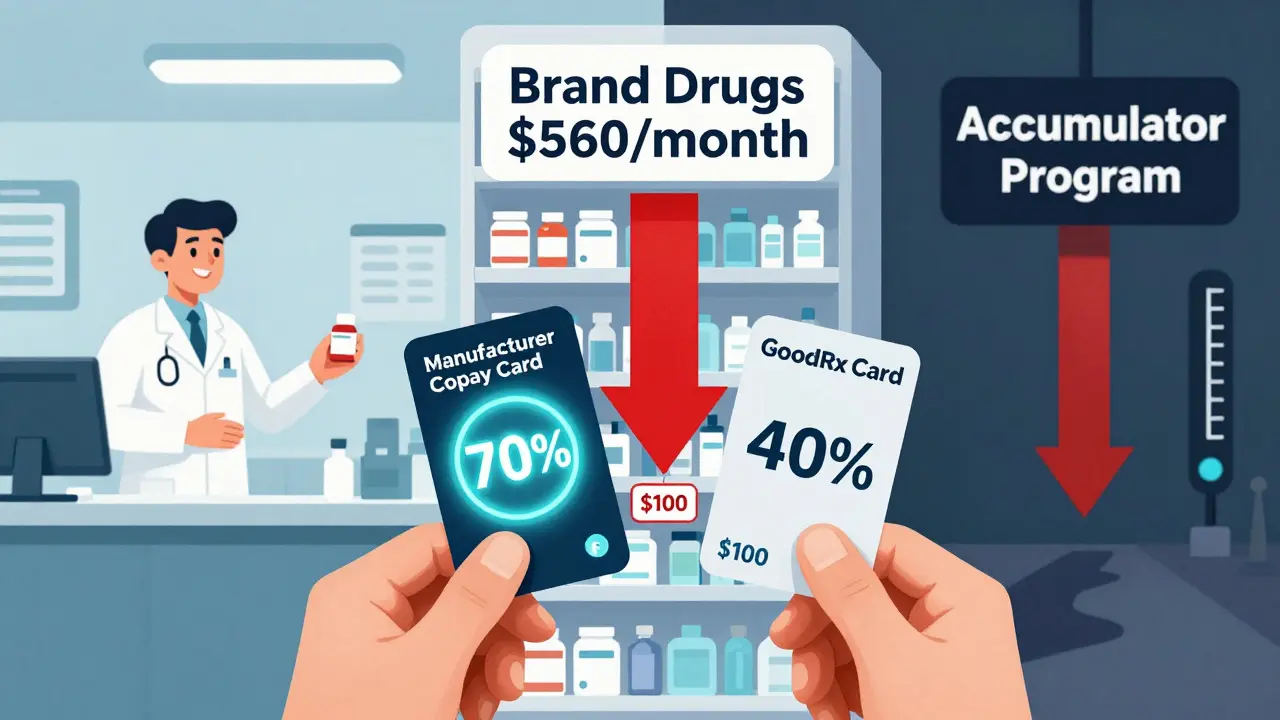
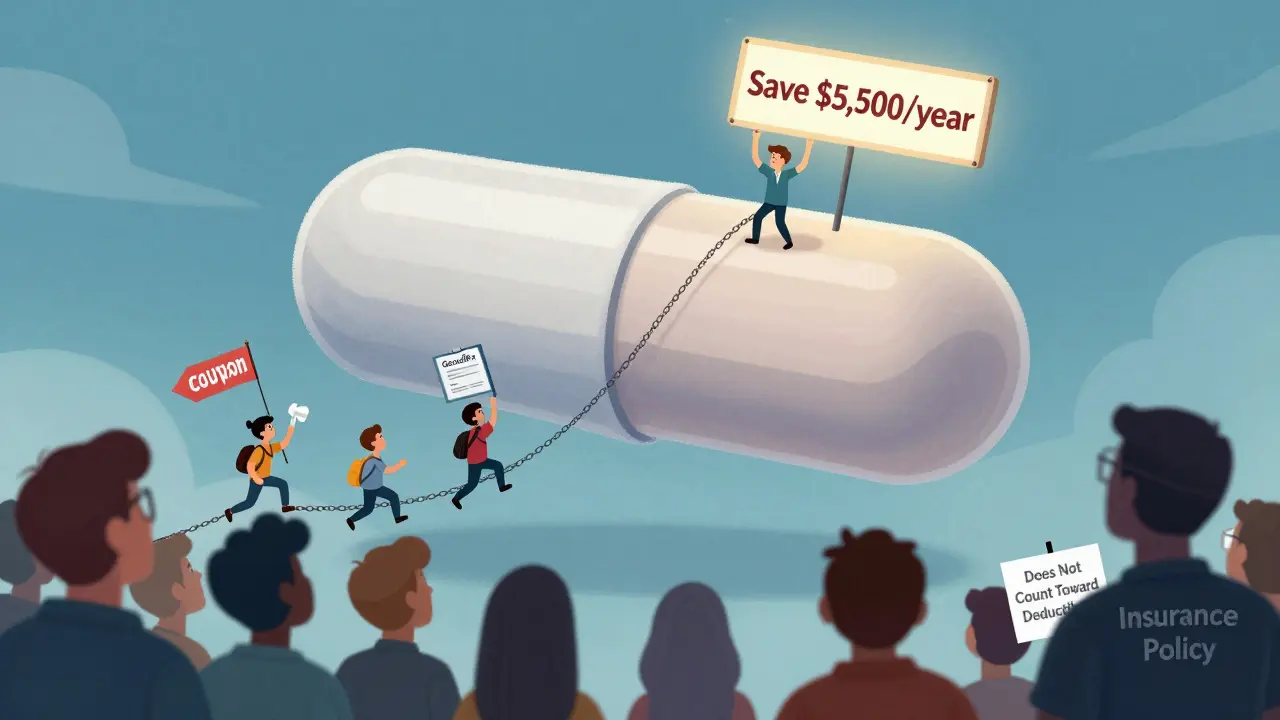
These are financial help programs created directly by pharmaceutical companies. The two main types are copay cards (or coupons) and patient assistance programs (PAPs). Copay cards reduce your out-of-pocket cost at the pharmacy right away. PAPs are usually for people with very low income or no insurance, offering free or deeply discounted drugs.They’ve been around since the early 2000s, when drug prices started climbing and insurance plans began making patients pay more. Today, nearly 1 in 5 prescriptions for privately insured patients in the U.S. use one of these programs. In 2023 alone, they saved patients $23 billion. That’s real money. For someone on a $560/month diabetes drug, a coupon might drop that to $100. That’s a $5,500 annual saving.
Who Can Use These Programs?
You’re eligible if you have private insurance-like through an employer or bought on the marketplace. You cannot use them if you’re on Medicare, Medicaid, or any other federal health program. Why? Because federal law bans drugmakers from giving discounts to people on government plans. It’s seen as an illegal kickback.Even if you have private insurance, not every plan accepts these cards. Some insurers have something called an accumulator adjustment program. That means your manufacturer discount doesn’t count toward your deductible or out-of-pocket maximum. So even though you pay less at the pharmacy, you still have to meet your full deductible later. That can wipe out the benefit. Check your plan documents or call your insurer to ask: "Does my plan allow manufacturer coupons to count toward my deductible?" If they say no, you might be better off with a GoodRx card instead.
How to Find and Enroll in a Program
Start by going to the drug manufacturer’s official website. Search for your exact medication name-like "Jardiance savings program" or "Humira patient assistance." Most companies have a dedicated page. You can also use free tools like GoodRx or NeedyMeds, which list available programs and links.Once you find the right page, fill out a short form. You’ll need:
- Your full name and contact info
- Your insurance details (carrier, member ID, group number)
- Your prescriber’s name and phone number
- Your pharmacy’s name and address
After you submit, you’ll get a digital card via email or text. Some programs mail a physical card. Either way, you’ll get a unique ID number. That’s your key to the discount.
How the Discount Works at the Pharmacy
When you show up to fill your prescription, hand over your insurance card and your manufacturer coupon. The pharmacy’s system sends both to a third-party administrator-like ConnectiveRx or Prime Therapeutics. That company checks:- That you’re eligible
- That your drug is covered by the program
- That you haven’t hit the annual cap
If everything checks out, the discount is applied instantly. You pay only your reduced copay. The manufacturer pays the rest to the administrator, who then pays the pharmacy. You never see the full price. That’s the point.
What You Need to Know About Limits
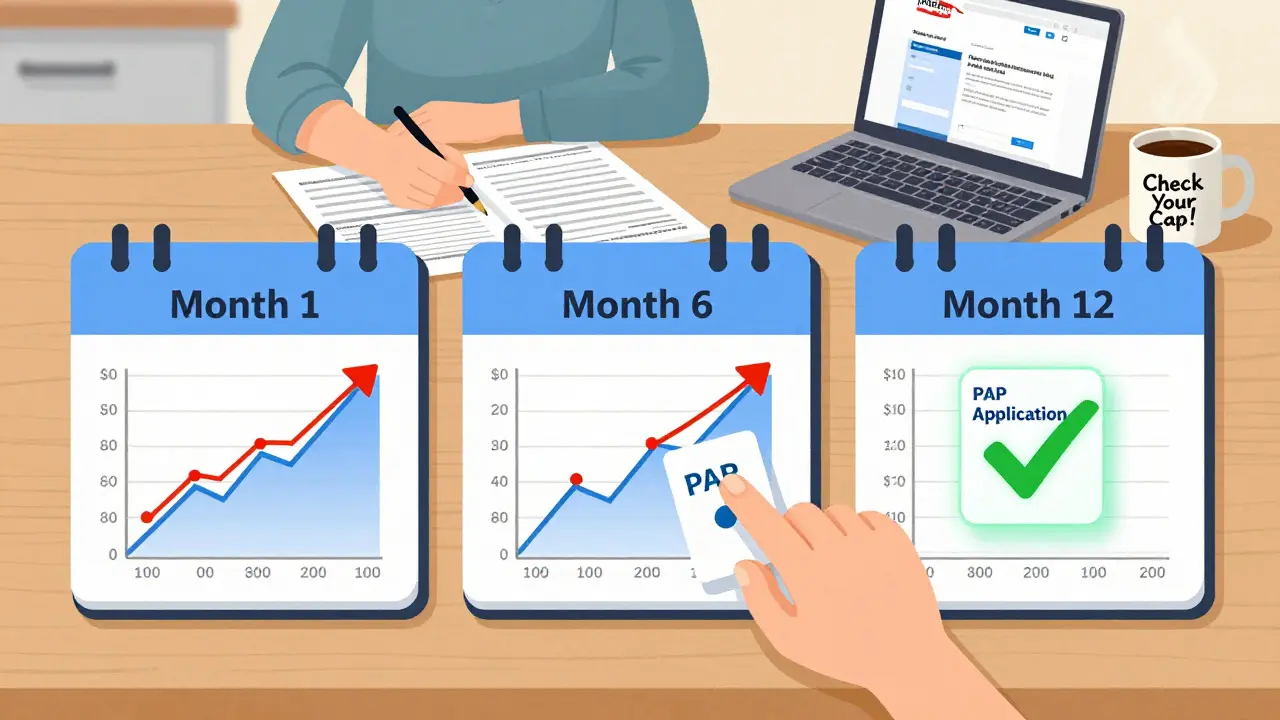
These programs aren’t free forever. Most have:- Annual caps: Usually between $5,000 and $15,000 per person per year. Once you hit it, you pay full price until the next calendar year.
- Time limits: Many programs last only 12 or 24 months. After that, you must reapply. Some require proof of income or insurance again.
- Drug-specific rules: Not every dose or formulation is covered. Check if your prescription strength is included.
For example, a patient on Jardiance for diabetes might get $450 off each month-$5,400 a year. That’s under the $15,000 cap, so they’re fine. But someone on a $1,200/month drug like Humira might max out in just 12 months. Then they’re stuck paying $1,200 again. That’s why knowing your cap matters.
Manufacturer Programs vs. Pharmacy Discount Cards
You’ve probably seen GoodRx, SingleCare, or RxSaver. These are different. They’re not made by drugmakers. They’re middlemen that negotiate discounts with pharmacies. Here’s how they compare:| Feature | Manufacturer Savings Programs | Pharmacy Discount Cards (e.g., GoodRx) |
|---|---|---|
| Who offers it | Drug company | Third-party service |
| Eligibility | Private insurance only | Anyone-no insurance needed |
| Discount depth | 70-85% off | 30-60% off |
| Applies to generics? | No | Yes |
| Counts toward deductible? | Usually not (if accumulator program) | No |
| Annual cap | Yes ($5K-$15K) | No |
| Expiration | 12-24 months | None |
So if you have insurance and want the deepest discount, use the manufacturer card. If you’re uninsured, on Medicare, or want to save on generics, use GoodRx. You can even compare prices on both before you go to the pharmacy.
Real User Experiences
People on Reddit, Drugs.com, and patient forums talk about these programs constantly. One common story: a user on Jardiance went from $562/month to $100/month thanks to the coupon. Another, on a biologic for rheumatoid arthritis, saved $1,100/month-until the program ended. Then their bill jumped to $1,400. They had no warning.That’s the dark side. Programs can disappear. Companies change terms. Insurers change rules. A 2023 survey found 42% of users faced unexpected problems: their plan stopped accepting coupons, their cap was hit, or their drug was removed from the program. Always check your program status every 3-6 months. Set a calendar reminder.
What to Do If Your Program Ends
If your manufacturer coupon stops, don’t panic. First, call your doctor. Ask if there’s a similar drug with a better savings program. Sometimes switching to another brand in the same class (like from Humira to Cimzia) can save you thousands.Second, ask your pharmacist about the lowest cash price. Sometimes, paying cash with a GoodRx card is cheaper than your insurance copay-even with the manufacturer discount gone.
Third, check if you qualify for a PAP. Some manufacturers offer free drugs if your income is under 400% of the federal poverty level. You’ll need to submit tax forms or pay stubs, but it’s worth it.
Watch Out for These Pitfalls
Here’s what trips people up:- Using the wrong pharmacy: Not all pharmacies participate. Always check the program’s list before you go.
- Not renewing: If your card expires in 12 months and you forget, you pay full price for weeks.
- Missing the cap: If your drug costs $1,000/month and your cap is $10,000, you’ll hit it in 10 months. Plan ahead.
- Assuming it counts toward your deductible: If your plan has an accumulator program, your discount doesn’t move you closer to your out-of-pocket max. You’ll still owe more later.
Many patients don’t realize their pharmacist can help. In fact, 65% of people need help from their pharmacy staff just to enroll. Don’t be shy. Ask them to walk you through it.
The Bigger Picture
These programs help millions. But they’re not neutral. Drugmakers use them to keep people on expensive brand drugs instead of switching to cheaper generics. Studies show they increase brand sales by 60% or more. Critics say they distort the market and push prices higher for everyone else. Supporters say they’re lifelines for people who can’t afford their meds.Legislation is changing. The Inflation Reduction Act capped insulin at $35 for Medicare users. That’s already reducing reliance on coupons for insulin. And bills are being introduced to force manufacturers to count their discounts toward deductibles. If that passes, these programs might change-or disappear.
For now, they’re still one of the best ways to cut your drug costs. But use them smartly. Know the rules. Track your usage. And always have a backup plan.
Can I use manufacturer savings programs if I’m on Medicare?
No. Federal law prohibits drug manufacturers from offering discounts to people enrolled in Medicare, Medicaid, or other government health programs. This is to prevent illegal kickbacks. If you’re on Medicare, you can use the $35 insulin cap or ask about patient assistance programs that are allowed under Medicare rules.
Do these programs work with all pharmacies?
No. Only pharmacies that have contracts with the manufacturer’s third-party administrator (like ConnectiveRx) can process the discount. Always check the program’s website for a list of participating pharmacies before you go. Some large chains like CVS, Walgreens, and Rite Aid usually participate, but smaller local pharmacies may not.
What if my insurance denies the manufacturer coupon?
If your insurance rejects the coupon, ask your pharmacist to try again with a different insurance ID or to submit the claim manually. Sometimes it’s a system glitch. If it still doesn’t work, ask if your plan has an accumulator program. If so, you may be better off using a GoodRx card instead. You can also call the manufacturer’s help line-they often have staff who can troubleshoot.
Can I use a manufacturer coupon and a GoodRx card together?
No. You can only use one discount at a time. The pharmacy’s system will only accept one. Always compare the final price you’d pay with each option before choosing. Sometimes GoodRx gives a better deal, especially if your manufacturer coupon has a low cap or your plan blocks it.
How often do these programs change or end?
They change often. Programs can be discontinued, capped lower, or have eligibility rules tightened. Some last only a year. Always check the program website monthly. Set a reminder on your phone to check every 90 days. If a program ends, your drug cost could jump by $1,000 or more overnight. Don’t wait for the bill to arrive.


OMG this saved my life 💖 I was paying $600/month for my insulin until I found the manufacturer coupon-now it’s $35. Why isn’t everyone talking about this??