
Drug Shortage Substitution Calculator
Find Safe Substitutions During Shortages
Based on FDA guidelines and clinical evidence from the article. Enter the drug you're missing and current dose to calculate evidence-based alternatives.
Enter your drug and dose to see substitution options
Important: Always verify substitutions with your pharmacy team. Substitutions may require dose adjustments and clinical monitoring.
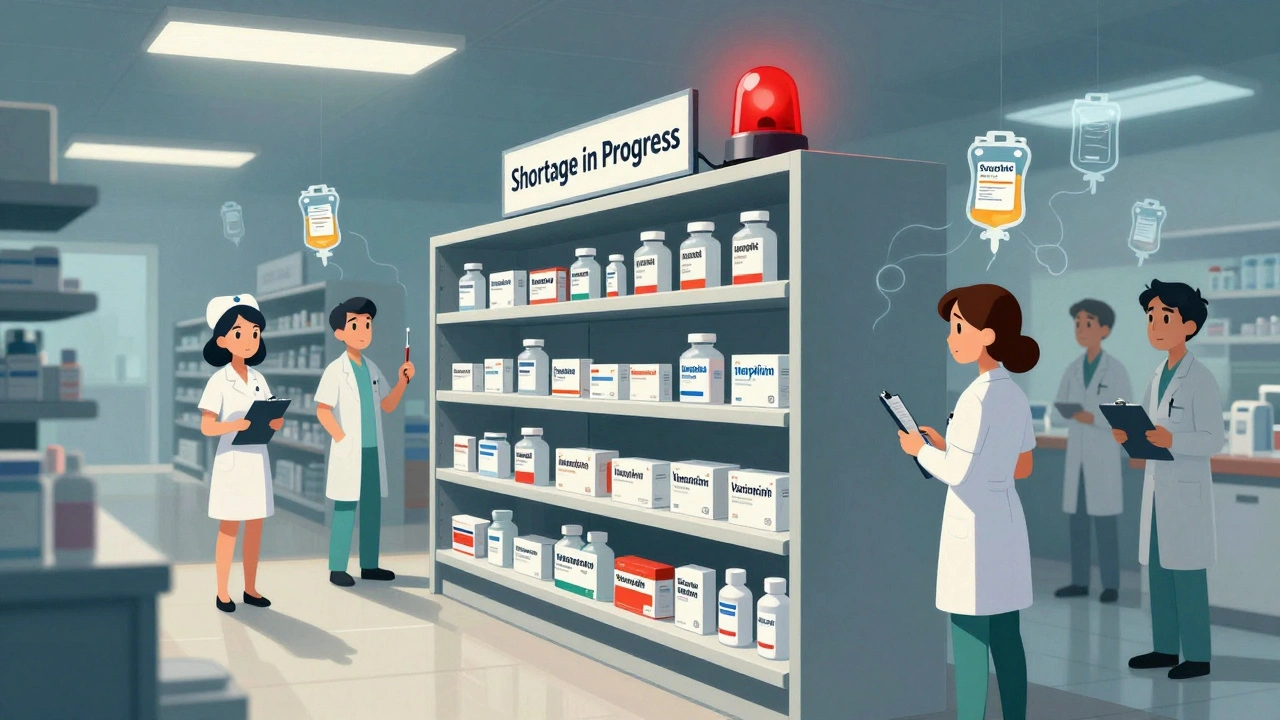
When your hospital runs out of morphine, or the IV antibiotics your patient needs don’t arrive, it’s not a glitch-it’s a systemic failure. Medication shortages aren’t rare surprises anymore. They’re a constant, grinding reality in hospitals, clinics, and pharmacies across the U.S. and beyond. In 2022, there were 287 documented drug shortages affecting nearly one in five essential medications in hospital formularies. And it’s not just about running out of stock. It’s about delayed surgeries, increased errors, longer wait times, and patients getting less effective-or riskier-treatments because nothing else is available.
What’s Actually Running Out?
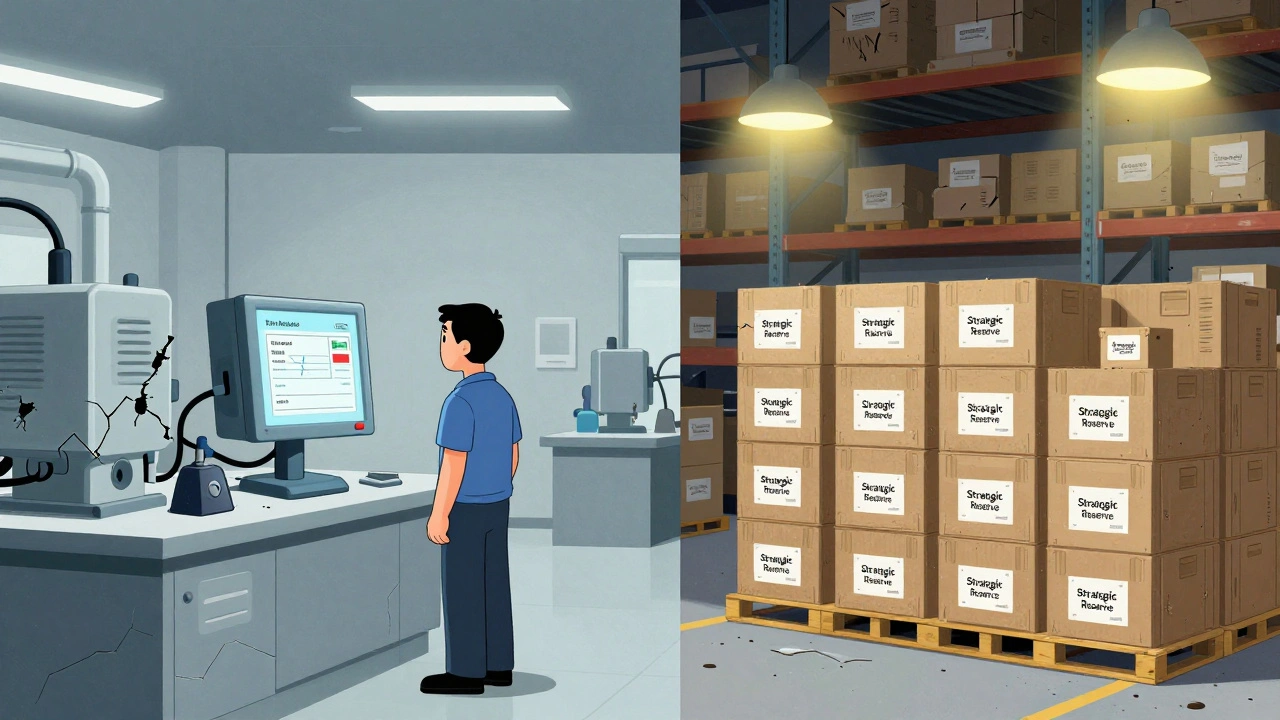
It’s not random. The drugs most likely to disappear are generic sterile injectables. These are the medicines you don’t think about until you need them: saline bags, morphine, antibiotics like vancomycin, chemotherapy drugs, anesthetics, and IV nutrition. They make up 63% of all shortages. Why? Because they’re cheap to make, have razor-thin profit margins, and are produced by just a handful of manufacturers. Three companies control 75% of the U.S. supply for these critical drugs. If one plant shuts down for a quality issue, the entire country feels it.Quality problems are the main culprit. In 2022, 46% of shortages were caused by manufacturing defects-contaminated batches, failed sterility tests, or equipment breakdowns. That’s down from over 60% a few years ago, but still the top reason. These aren’t small mistakes. They’re failures in clean-room environments where even a speck of dust can ruin a batch of life-saving medicine. And because these drugs are made in large volumes at low cost, companies don’t invest heavily in backup systems or redundant equipment.
Why This Keeps Happening
It’s not just bad luck. It’s broken economics. Generic drug makers operate in a market where prices are locked in by government programs like Medicaid and the 340B program. These programs demand the lowest possible price, and manufacturers can’t raise prices even when costs go up-say, because of a new FDA inspection or a spike in raw material prices. If they can’t make money on a drug, they stop making it. And because there’s no national stockpile of these medicines, there’s no safety net.Compare that to countries like Germany or Canada. Germany keeps strategic reserves of critical drugs. Canada requires manufacturers to report potential shortages months in advance. Both have cut the average length of shortages by over a third. In the U.S., manufacturers only have to notify the FDA after a shortage starts-and even then, compliance is only around 65%. That means hospitals often find out a drug is gone when the delivery truck doesn’t show up.
How Hospitals Are Trying to Cope
Frontline teams are scrambling. Pharmacy directors report learning about shortages only when orders fail to arrive-too late to plan. Nurses see patients waiting an extra 22 minutes for critical meds. Pharmacists are forced to substitute drugs like morphine with hydromorphone, which increases the risk of dosing errors by 15%. One hospital pharmacist on Reddit described having to retrain the whole unit in 48 hours after a morphine shortage hit-no time to practice, no time to get it right.Best practices exist, but they’re expensive. The most effective hospitals set up a shortage management team with pharmacists, nurses, IT staff, risk managers, and finance reps-all empowered to act fast. They meet weekly during normal times, and within 4 hours of a shortage alert. They track every substitution, every error, every delay. They keep buffer stocks of 14 to 30 days for top-critical drugs. But only 35% of safety-net hospitals can afford that. Most manage with 8 to 12 days of inventory, if that.
Training matters too. Hospitals that run quarterly simulation drills-mock shortages, real-time decisions, team responses-see 33% fewer medication errors during actual crises. That’s not luck. It’s preparedness.
What You Can Do as a Clinician
You don’t need a hospital committee to start managing shortages. Here’s what works:- Know your formulary’s critical drugs. Make a list of the 10-15 medications you can’t afford to lose. Check their availability monthly.
- Build a substitution protocol. Don’t wait until the drug is gone to figure out what to use instead. Work with your pharmacy to map out safe, evidence-based alternatives for each high-risk drug. Document dosing, warnings, and monitoring needs.
- Track your own data. If you notice delays or errors during a shortage, write it down. Numbers change policy. One nurse’s log of 17 delayed chemo doses can become a departmental report that pushes leadership to act.
- Communicate with patients. If you have to switch a drug, explain why. Patients are more willing to accept change if they understand the reason. Say: “We’re having a supply issue with your usual medication, so we’re switching to this one. It works the same way, but we’ll watch you more closely.”
- Speak up. Tell your hospital administration. Write to your state pharmacy board. Contact your legislators. The system won’t fix itself unless people demand change.
The Bigger Picture: What Needs to Change
Shortages aren’t going away unless the system changes. Experts agree on three big fixes:- Reform reimbursement. Medicare Part B pays for drugs based on average sales price. If a manufacturer invests in reliable production, they shouldn’t be punished by lower reimbursement. Reward reliability with better payment.
- Build a national strategic stockpile. Not for emergencies like pandemics-for daily use. Keep reserves of the top 50 shortage-prone drugs. Germany does it. We should too.
- Require early reporting. Make manufacturers report potential shortages at least 6 months in advance. Enforce it. Fine them if they don’t.
There’s also promise in new tech. Advanced manufacturing-like continuous production lines that can switch between drugs in hours instead of weeks-could cut shortage frequency by 40%. But it needs investment. Right now, the industry is stuck in an outdated model: make huge batches, store them for months, and hope nothing goes wrong.
What’s Next?
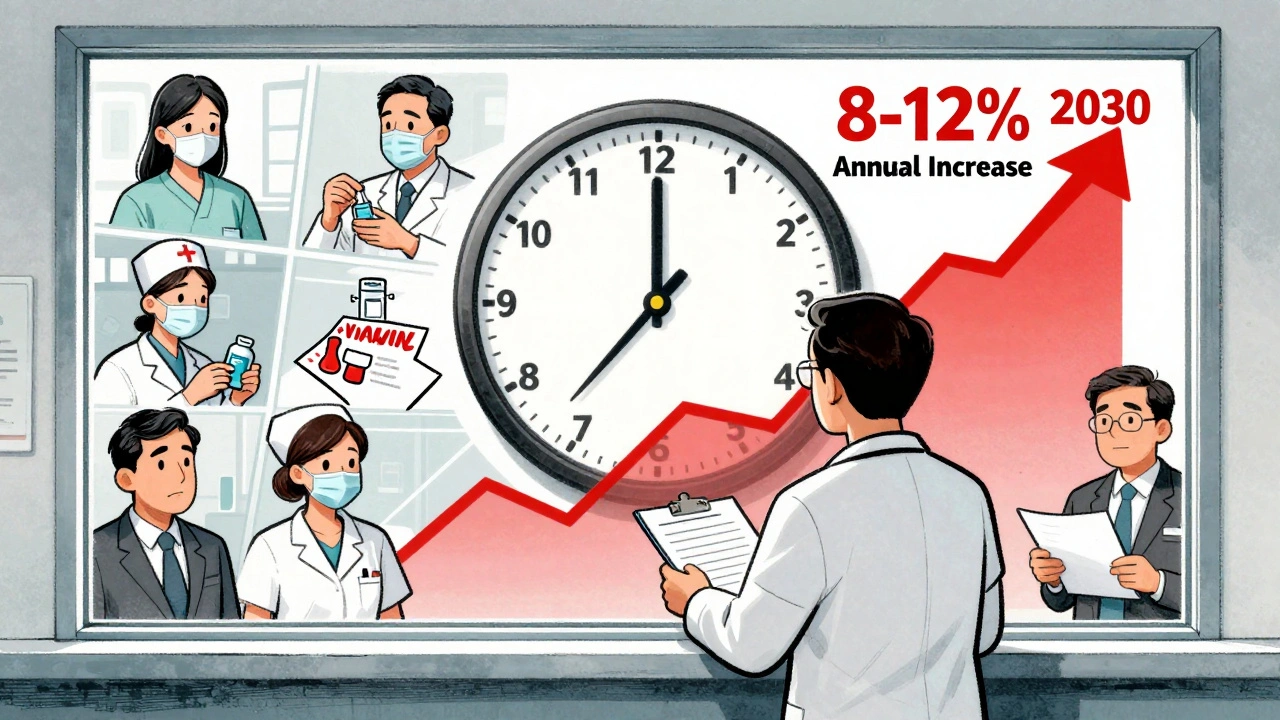
Without action, shortages will grow by 8-12% each year through 2030. Oncology, anesthesia, and critical care drugs will be hit hardest. The cost to hospitals? $218,000 per shortage annually-$1.2 billion total. That’s not just money. It’s delayed surgeries, preventable deaths, and exhausted staff.Managing shortages isn’t about finding a miracle solution. It’s about doing the basics well: planning ahead, tracking data, training teams, and pushing for accountability. Every hospital, every clinic, every pharmacist and nurse has a role. The system is broken, but it’s not beyond repair. What we do today-how we respond, how we speak up, how we prepare-will determine whether the next patient gets the right drug, or just the one that happens to be in stock.
What are the most common drugs in shortage right now?
As of late 2025, the most frequently shorted drugs are generic sterile injectables: saline solutions, morphine, fentanyl, vancomycin, propofol, and chemotherapy agents like doxorubicin and cisplatin. IV nutrition (total parenteral nutrition) and emergency crash cart drugs like epinephrine and atropine are also consistently affected. These are not new drugs-they’re foundational to modern care. Their scarcity reflects systemic production failures, not lack of demand.
Can I just order more from another supplier?
It’s not that simple. Most generic injectables are produced by only one or two manufacturers. Even if you find another supplier, they may not have FDA approval for that exact product, or their version may have different additives or concentrations. Substituting without proper clinical review can lead to dosing errors or adverse reactions. Always check with your pharmacy team before switching. They have access to databases that verify therapeutic equivalence and safety.
How long do drug shortages usually last?
The average duration has grown from 6.2 months in 2015 to 9.8 months in 2022. For oncology drugs, shortages can last over 14 months. Some last less than a month if the issue is minor, like a labeling error. Others take years to resolve if a manufacturing plant needs major FDA-cleared upgrades. There’s no way to predict exactly when a drug will return-only that it won’t be soon.
Are brand-name drugs affected too?
Rarely. Brand-name drugs usually have higher profit margins, which allow companies to invest in multiple production sites, backup suppliers, and quality systems. But some brand-name drugs that rely on complex manufacturing or single-source ingredients can still be affected-especially if they’re made overseas. For example, some biologics and specialty injectables have faced shortages due to raw material delays from India or China.
Is there a way to know about shortages before they happen?
Yes, but you have to look. The FDA’s Drug Shortage Database is updated daily and is the most reliable public source. ASHP also publishes weekly shortage alerts for members. Some hospitals subscribe to commercial services like MedScape’s Drug Shortage Tracker or Lexicomp’s alerts. Proactive monitoring-checking these sources weekly-is the only way to stay ahead. Waiting for a delivery to fail means you’re already behind.
What should I do if a patient’s life depends on a drug that’s out of stock?
First, contact your pharmacy immediately. They may have access to alternative suppliers, including emergency stockpiles or international sources (though importation is tightly regulated). If no alternative exists, consult with your medical director or ethics committee. In extreme cases, patients may be transferred to a facility with access to the drug. Document every step. Never guess or improvise a dose without clinical guidance. Patient safety always comes before convenience.
Why aren’t more drugs made in the U.S.?
It’s cheaper to make them overseas. About 80% of the active ingredients in U.S. drugs come from China and India. Building a new FDA-compliant sterile injectable facility in the U.S. costs over $100 million. With low profit margins on generics, companies don’t see the return. Even when U.S. production is possible, the market doesn’t reward it. Until reimbursement models change, manufacturing will stay concentrated where costs are lowest-even if it puts patient care at risk.


Been there. Last month we ran out of morphine for a week. Had to switch to hydromorphone and holy hell, the dosing errors spiked. One nurse gave 0.8 mg instead of 0.08. Patient was fine, but we almost lost it. No one talks about how much mental load this puts on staff. We’re not just admins-we’re scrambling to keep people alive while the system ignores us.