
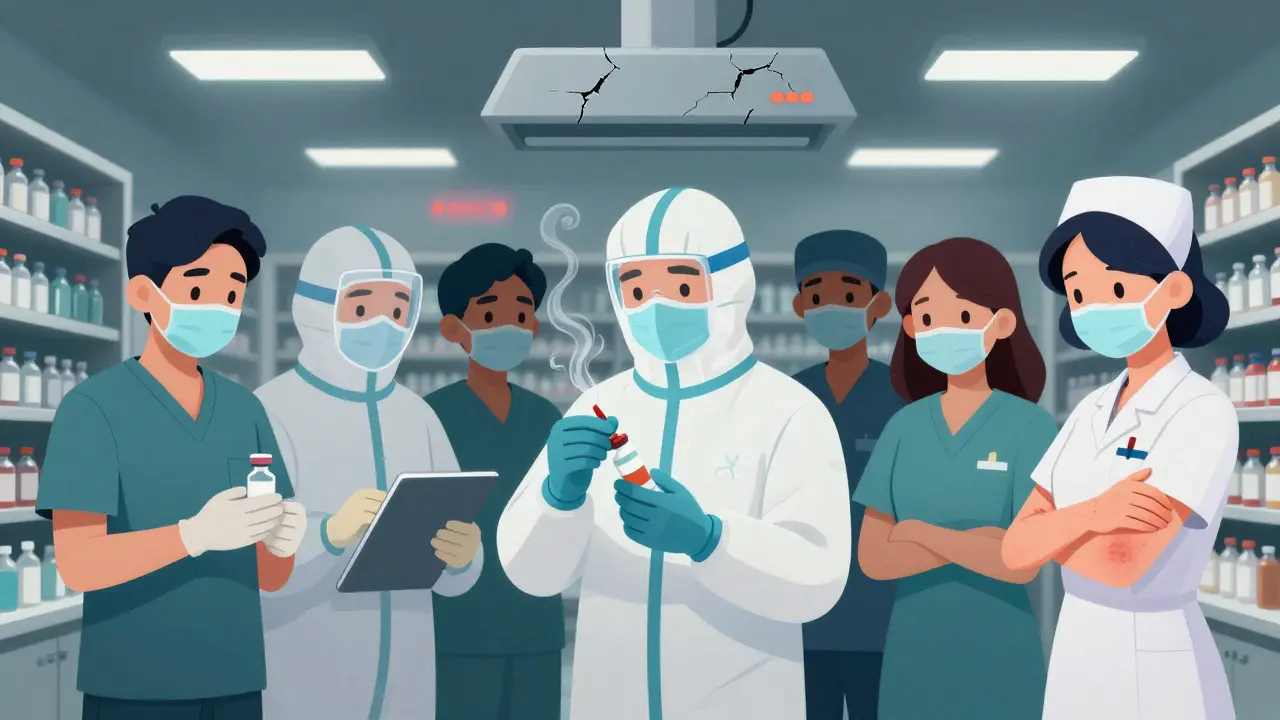
Every day, millions of workers take medications that help them manage pain, anxiety, or chronic illness. But what happens when those same medications make it harder to do their job safely? Or when their job exposes them to powerful drugs that can harm their health over time? This isn’t just a personal health issue-it’s a workplace safety crisis.
Two Sides of the Same Coin
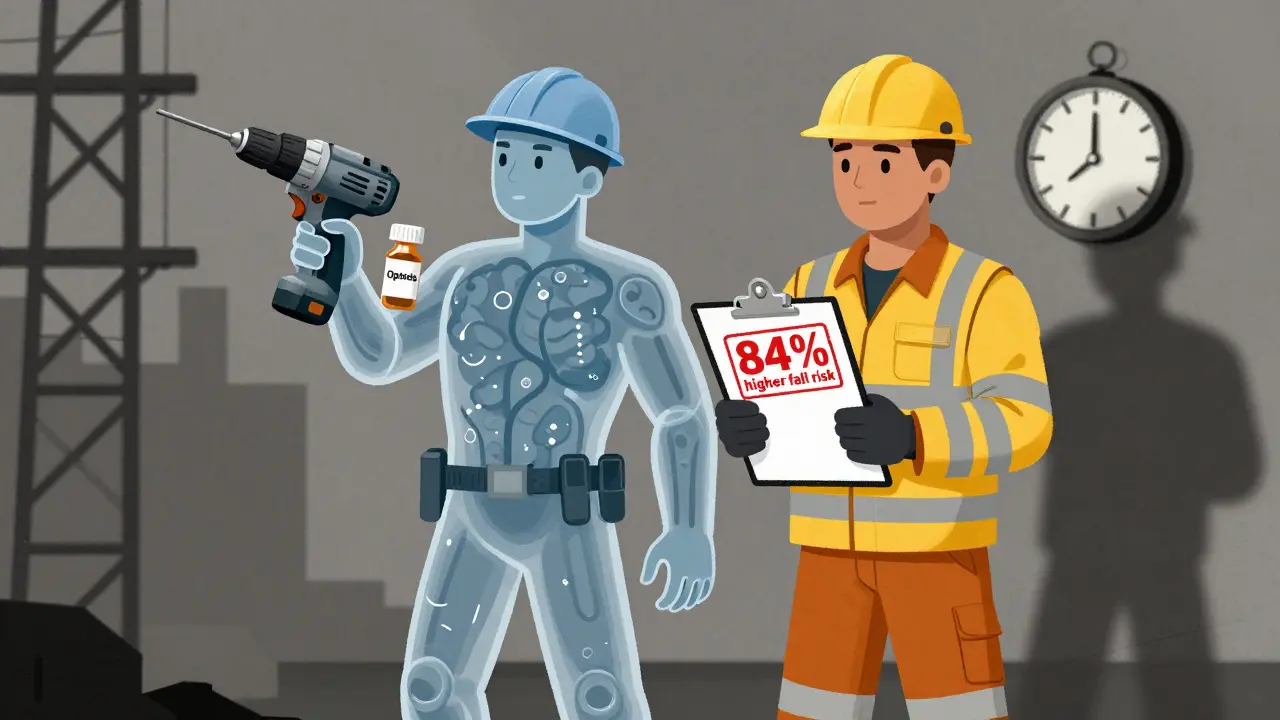
There are two major ways medications affect work safety. One involves workers who take prescription drugs like opioids or benzodiazepines. The other involves workers who handle hazardous drugs as part of their job-like nurses giving chemotherapy or pharmacists preparing IV drugs. Both scenarios carry real, measurable risks.Workers taking opioids for back pain are 2.1 times more likely to suffer a workplace injury than those who don’t. Benzodiazepines, often prescribed for stress or insomnia, can cause drowsiness, slowed reaction times, and poor coordination. When taken together, the risk of falls and accidents jumps by 84%. That’s not speculation-it’s backed by data from the Journal of Occupational and Environmental Medicine (2017).
On the flip side, healthcare workers handling antineoplastic drugs face a different kind of danger. These drugs are designed to kill fast-growing cells-cancer cells. But they don’t always know the difference between cancer and healthy tissue. A single drop of chemotherapy on the skin can cause rashes, nausea, or hair loss. Long-term exposure raises the risk of miscarriage, birth defects, and even cancer. According to the NIOSH 2024 List of Hazardous Drugs, there are now 370 drugs classified as hazardous in healthcare settings.
How Exposure Happens
You might think handling dangerous drugs means getting splashed with a full vial. But most exposures are quiet, invisible, and happen over time.- 38% come from breathing in tiny droplets or vapors during drug preparation or cleanup
- 29% result from skin or eye contact when a vial spills or a line breaks
- 22% happen when workers touch contaminated surfaces-gloves, counters, IV bags
- 7% come from poor hand hygiene, like eating lunch without washing up
- 4% are from needle sticks or sharps injuries
One chemotherapy nurse on Reddit shared her story: after three years of following all safety protocols, she developed chronic skin rashes. Surface tests later showed detectable drug residue in 68% of her work areas. That’s not negligence-it’s a system failure.
Who’s at Risk?
It’s not just oncology nurses. The highest-risk roles include:- Pharmacists and pharmacy technicians (32% of exposures)
- Oncology unit staff (28%)
- Ambulatory surgery center teams (19%)
- Housekeeping staff cleaning rooms after chemotherapy treatments
- Veterinary staff handling cancer drugs for pets
Even administrative staff can be exposed if they handle paperwork or equipment that’s been contaminated. A 2023 CDC study found that 1.8 million U.S. healthcare workers work in settings not covered by OSHA’s Hazard Communication Standard. That means no formal training, no safety plans, no monitoring. Just guesswork.
What Works: Real Solutions
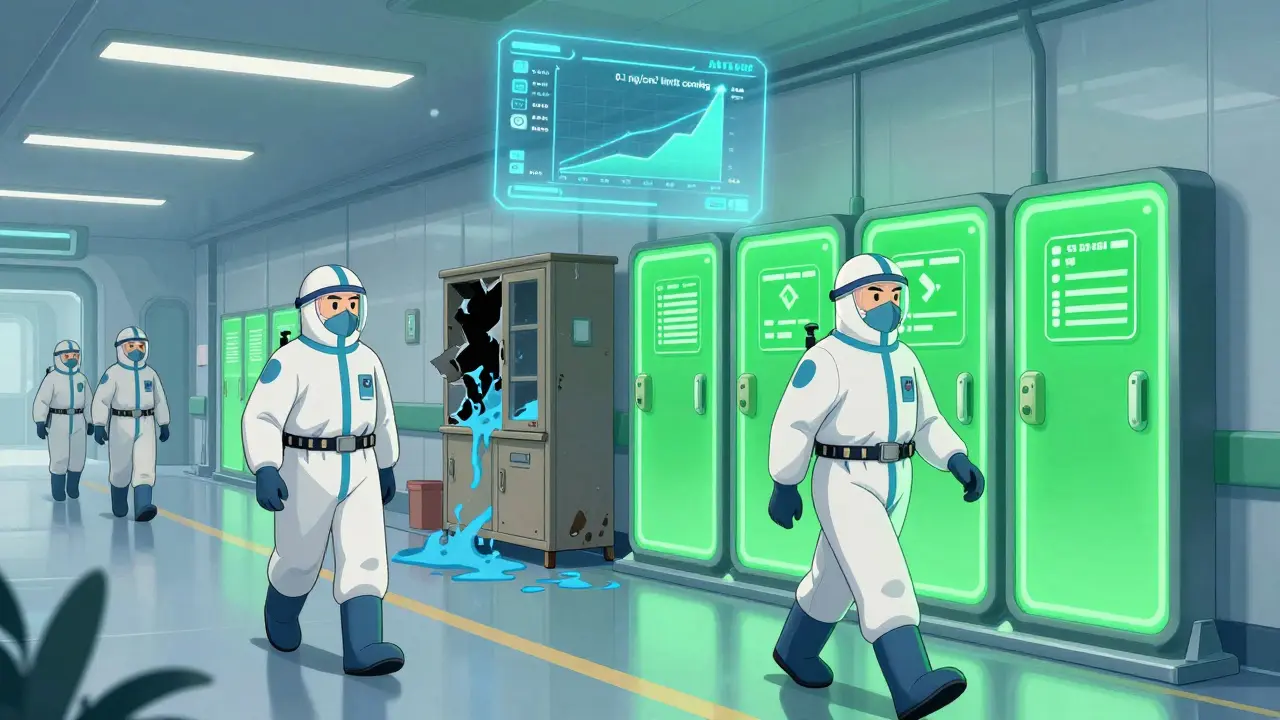
The good news? We know how to stop this.Engineering controls are the most effective. Closed-system transfer devices (CSTDs) seal drug vials and IV lines during transfer, preventing aerosols and spills. In one hospital, using CSTDs cut surface contamination by 94.7%. At Mayo Clinic, a full safety overhaul-including CSTDs, better ventilation, and training-reduced exposures by 89%.
Administrative controls matter too. Workers need 16-24 hours of initial training, plus 4-8 hours every year. They need clear procedures for handling spills, disposing of waste, and donning PPE. A CDC field study found that 43% of workers didn’t properly wear gloves or gowns-even after training. That’s not just carelessness. It’s a sign that training isn’t working.
And it’s not just about gear. Unionized healthcare workers report 22% fewer medication-related incidents than non-unionized staff. Why? Better communication, stronger safety culture, and more accountability.
The Cost of Doing Nothing
This isn’t just about health. It’s about money.The annual cost of occupational medication incidents in the U.S. is $4.7 billion:
- $2.1 billion in direct medical costs
- $1.8 billion in lost productivity
- $0.8 billion in workers’ compensation claims
And it’s getting worse. The hazardous drug safety equipment market is projected to hit $3.8 billion by 2028. That’s because more hospitals are finally realizing: skipping safety measures costs more than fixing them.
But progress is uneven. Only 78% of large hospitals (200+ beds) have full hazardous drug programs. Among smaller clinics and outpatient centers, that number drops to 34%. Many still use outdated cabinets, broken ventilation systems, or expired gloves. One audit found 31% of facilities had safety cabinets that didn’t seal properly. That’s like locking your door with a rubber band.
What Employers Must Do
If you manage a workplace where drugs are used or handled, here’s what you need to do:- Use the NIOSH 2024 List of Hazardous Drugs to identify what’s in your facility
- Test surfaces and air for contamination every 6 months
- Install closed-system transfer devices for all hazardous drug handling
- Train every worker-nurses, cleaners, pharmacists, even interns
- Require proper PPE and enforce its use
- Keep records as required by OSHA 29 CFR 1910.1200
Don’t wait for someone to get sick. The FDA now requires boxed warnings on 27 antineoplastic drugs about occupational exposure risks. That means regulators are watching. And fines are rising. In Q1 2024 alone, OSHA issued 147 citations totaling $1.2 million for hazardous drug violations.
What Workers Should Know
If you’re taking prescription opioids or benzodiazepines:- Don’t hide it. Talk to your doctor about how your meds affect your job
- Ask: Can I switch to a non-sedating alternative?
- Never mix opioids and benzodiazepines unless your doctor specifically says it’s safe
- Report dizziness, drowsiness, or slowed reactions immediately
If you handle hazardous drugs:
- Know the 2024 NIOSH list. If you’re unsure if a drug is hazardous, assume it is
- Always use two pairs of gloves. Change them immediately if torn or contaminated
- Wash hands before eating, drinking, or touching your face-even if you wore gloves
- Report spills, leaks, or broken equipment. Don’t wait for someone else to fix it
- Track your symptoms. Skin rashes, nausea, hair loss, or irregular periods could be early signs
The Bigger Picture
Some argue that drug-free workplace policies unfairly punish workers who need medication for legitimate conditions. A 2021 editorial in the Journal of Occupational Rehabilitation found that 32% of workers lost their jobs due to necessary medication use-even when they never had a safety incident.This is a real problem. But the answer isn’t to ignore risks. It’s to build smarter systems. Instead of blanket bans, employers should work with workers and doctors to find safe alternatives. Maybe a worker with chronic pain can switch from opioids to physical therapy. Maybe a nurse with anxiety can try cognitive behavioral therapy instead of benzodiazepines.
And for those handling hazardous drugs? The solution isn’t to scare them-it’s to equip them. Training, technology, and trust work better than fear.
NIOSH and OSHA are pushing forward. New AI systems are being tested at Johns Hopkins to predict exposure risks before they happen. OSHA may soon set a legal limit for surface contamination at 0.1 ng/cm². But change won’t come from regulations alone. It comes from workers speaking up, employers listening, and everyone treating safety like a shared responsibility-not a checklist.
What’s Next?
New cancer drugs are being approved faster than ever. In 2023, 42% of new oncology drugs had no established safety limits for workers. That means today’s standard practices may not protect against tomorrow’s drugs.That’s why ongoing education matters. What’s safe today might not be safe tomorrow. Stay updated. Ask questions. Demand better. Because no one should have to choose between their job and their health.
Can I be fired for taking prescribed medication at work?
It depends. If your medication impairs your ability to perform your job safely-like driving, operating machinery, or handling hazardous drugs-your employer may have grounds to restrict your duties. But under the Americans with Disabilities Act (ADA), employers must provide reasonable accommodations unless it creates an undue risk. If you’re taking medication for a diagnosed condition, talk to your doctor and HR about alternatives or adjustments. You cannot be fired simply for taking a prescribed drug unless it directly endangers safety and no safe alternative exists.
Are over-the-counter drugs a safety risk at work?
Yes. Antihistamines like diphenhydramine (Benadryl) can cause drowsiness. Pain relievers like tramadol can affect coordination. Even some cold and allergy meds have sedating effects. If you’re working in a safety-sensitive role-like construction, healthcare, or transportation-always check labels for warnings about drowsiness or impaired alertness. Talk to your pharmacist before taking any new OTC drug if you’re unsure.
How do I know if a drug is hazardous?
Check the NIOSH 2024 List of Hazardous Drugs. It’s updated annually and includes 370 drugs used in healthcare. The list is divided into antineoplastic agents, non-antineoplastic hazardous drugs, and drugs with reproductive effects. If you’re unsure, assume the drug is hazardous until proven otherwise. Always review the Safety Data Sheet (SDS) that comes with the drug-it’s required by law.
Do I need special training to handle chemotherapy drugs?
Yes. Under U.S. Pharmacopeia Chapter 800, anyone who handles hazardous drugs-including preparation, administration, transport, or cleanup-must receive initial training of 16-24 hours and annual refresher training of 4-8 hours. Training must cover exposure routes, proper PPE use, spill response, and waste disposal. If your employer hasn’t provided this, ask for it. It’s not optional-it’s a legal requirement in most healthcare settings.
What should I do if I think I’ve been exposed to a hazardous drug?
Immediately wash the affected area with soap and water. Remove contaminated clothing. Report the exposure to your supervisor and occupational health department. Document the drug name, amount, route of exposure, and symptoms. Even if you feel fine, get a medical evaluation. Some effects-like reproductive harm or cancer risk-take years to appear. Early reporting helps track patterns and prevent future incidents.
Is there a safe way to take opioids for chronic pain and still work safely?
It’s possible, but risky. Opioids slow reaction time and impair judgment. If you must take them, work with your doctor to use the lowest effective dose, avoid long-acting formulations if possible, and never combine them with alcohol, benzodiazepines, or sleep aids. Avoid safety-sensitive tasks like driving or operating machinery. Consider non-opioid alternatives like physical therapy, nerve blocks, or non-addictive pain medications. Many workers have successfully transitioned off opioids with proper support.


This is why India needs to stop pretending healthcare workers are disposable. We train them for years, pay them peanuts, then let them breathe in chemo fumes like it’s normal. The NIOSH list? It’s not a suggestion-it’s a death warrant for the underpaid. And don’t get me started on how hospitals skimp on CSTDs because ‘budget constraints.’ When your profit margin matters more than a nurse’s fertility, you’ve already lost your soul.
They call it ‘occupational hazard’ like it’s a weather pattern. No. It’s negligence dressed up in white coats.
And yes-I’m talking to you, corporate hospital boards sipping lattes in your corner offices. Your hands are dirty. You just don’t see the blood on them.
Someone’s gotta say it. And I’m not sorry.