
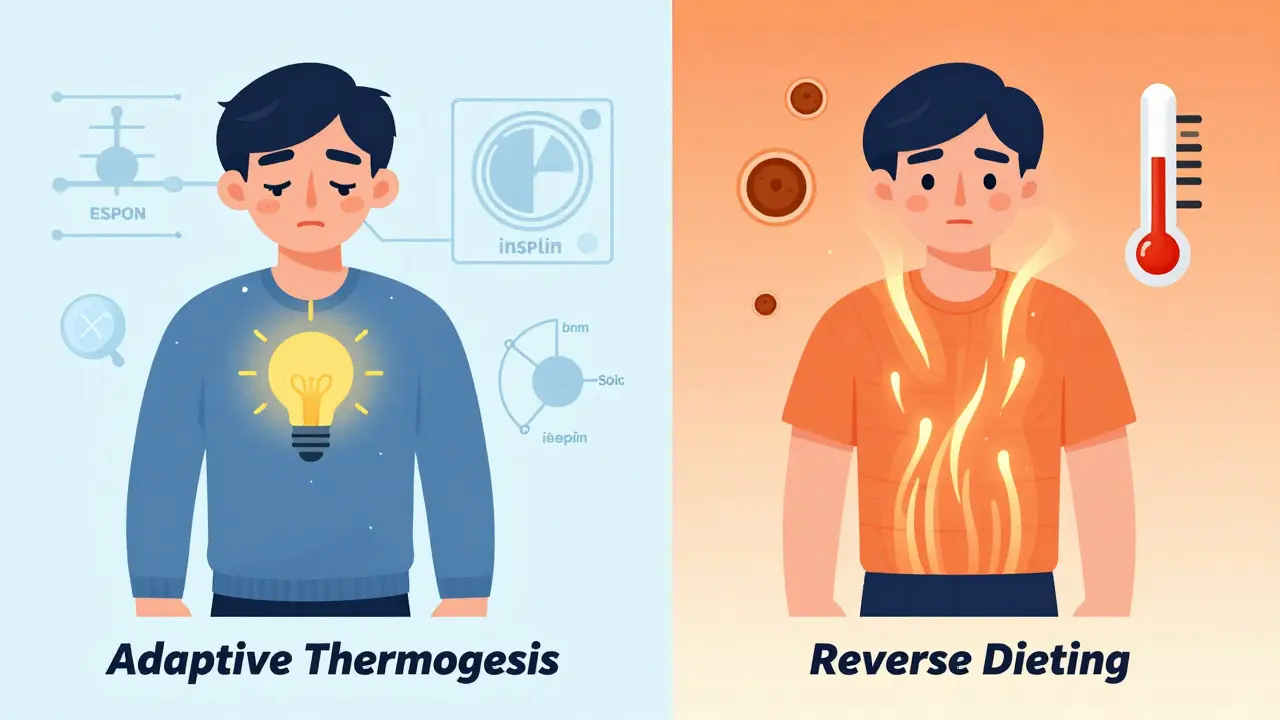
You’ve been doing everything right. You’re tracking your calories, hitting the gym, and sleeping well. Yet, the scale has stopped moving. Worse yet, you feel tired, cold, and hungry all the time. It’s not just stubborn fat; it might be your metabolism fighting back. This phenomenon is called adaptive thermogenesis, also known as metabolic adaptation. It is a biological survival mechanism that lowers your energy expenditure to conserve fuel during periods of calorie restriction. Understanding this process is crucial for anyone looking to lose weight sustainably or maintain their results without regaining pounds.
What Is Adaptive Thermogenesis?
Adaptive thermogenesis is defined as a change in your resting metabolic rate (RMR) that is greater than what would be predicted by changes in lean body mass and fat mass alone. In simpler terms, when you lose weight, your body expects you to need fewer calories because you have less tissue to move around. However, adaptive thermogenesis means your body goes beyond that mathematical expectation and actively slows down your engine to save energy.
This concept gained significant public attention after a study published in the New York Times regarding participants from 'The Biggest Loser.' The research showed that even years after losing massive amounts of weight, these individuals had metabolisms that were significantly lower than expected. Dr. Michael Rosenbaum from Columbia University describes this as creating "the ideal situation for weight regain." Your body essentially perceives weight loss as starvation and triggers counter-regulatory responses to protect your remaining energy stores.
The physiological impact is measurable. Research by S. Heinitz et al. (2020) documented that after just one week of caloric restriction, the average drop in 24-hour energy expenditure due to adaptive thermogenesis was about 178 kcal/day. While this number varies between individuals, a decrease of 100 kcal/day can predict roughly 2 kg less weight loss over six weeks. This isn't just theory; it's a real biological barrier that makes maintaining weight loss difficult for many people.
The Biology Behind the Slowdown
To understand why your metabolism slows, we need to look at the hormones involved. Adaptive thermogenesis involves a complex interaction between leptin, insulin, thyroid hormones, and stress hormones like cortisol and norepinephrine. When you restrict calories, leptin levels drop. Leptin is the hormone that tells your brain you have enough energy stored. Low leptin signals hunger and simultaneously reduces sympathetic nervous system activity, which lowers your heart rate and heat production.
Brown adipose tissue (BAT), often called brown fat, plays a key role here. Unlike white fat, which stores energy, brown fat burns calories to generate heat. Dr. Rosenbaum’s research suggests that as little as 25 grams of brown fat transitioning from an active to a minimally active state can account for a significant decline in resting energy expenditure. Essentially, your body turns off its internal heater to save fuel. This is why dieters often complain of feeling cold constantly-it’s a sign that adaptive thermogenesis is in full swing.
| Factor | Predicted Change (Based on Weight Loss) | Actual Change (With Adaptive Thermogenesis) |
|---|---|---|
| Resting Metabolic Rate | Decreases proportionally to lost mass | Decreases significantly more than predicted |
| Hunger Levels | Moderate increase | Significant, persistent increase driven by low leptin |
| Non-Exercise Activity Thermogenesis (NEAT) | Stable | Often decreases unconsciously (less fidgeting, movement) |
| Thyroid Hormone Activity | Normal adjustment | Reduced bioactive thyroid hormones to slow metabolism |
Reverse Dieting: A Strategy to Reset Metabolism
If adaptive thermogenesis is the problem, reverse dieting is often proposed as the solution. Reverse dieting involves gradually increasing your calorie intake after a period of restriction, with the goal of raising your metabolic rate back to baseline without gaining significant fat. The idea is to signal to your body that the "starvation" period is over, encouraging hormonal normalization and increased energy expenditure.
A typical protocol involves increasing daily calories by 50-100 kcal every 1-2 weeks. You monitor your weight closely. If the scale stays stable or moves up very slowly (less than 0.5% of body weight per week), you continue the increase. If you gain weight too quickly, you pause or reduce the increment. The entire process can take 3-6 months. During this time, maintaining high protein intake (1.6-2.2g per kg of body weight) is critical to preserve lean muscle mass, which is metabolically active tissue.
User experiences vary. A survey of MyFitnessPal users found that 68% reported experiencing metabolic adaptation, and 42% tried reverse dieting. Among those who tried it, 73% reported improved energy levels and 65% felt less hungry. However, success is not guaranteed. Some users report regaining weight despite careful tracking, suggesting that for some, the metabolic adaptation is profound and persistent. Combining reverse dieting with resistance training is widely considered the most effective approach, as building muscle helps offset the metabolic slowdown.
Common Pitfalls and How to Avoid Them
One of the biggest mistakes people make is increasing calories too rapidly. Jumping from a deficit straight to maintenance or surplus calories can lead to rapid fat gain because your metabolism hasn’t had time to adapt. Patience is key. Another common error is neglecting strength training. Without resistance exercise, much of the weight you regain will be fat, not muscle, which does little to boost your metabolic rate.
Also, be wary of oversimplified commercial programs. Many apps and diets promise a "metabolic reset" in two weeks, but scientific evidence suggests metabolic adaptation develops over months and takes time to reverse. Dr. Gabrielle Lyon, a physician specializing in muscle-centric medicine, recommends tracking indirect markers like resting heart rate and morning body temperature. A consistent drop in these metrics can indicate significant adaptive thermogenesis, signaling that you may need to adjust your strategy.
Long-Term Outlook and Future Research
While adaptive thermogenesis is a real challenge, it is not insurmountable. Current research is exploring new avenues to mitigate its effects. For instance, studies are investigating whether specific macronutrient compositions during reverse dieting, such as higher protein intakes, can accelerate metabolic recovery. Preliminary data from the NIH-funded RESTORE study suggests that high-protein diets may help preserve resting metabolic rate better than standard approaches.
Additionally, emerging technologies are allowing for personalized metabolic assessments. Companies are developing tools that use continuous glucose monitoring and indirect calorimetry to measure individual adaptive thermogenesis magnitude. This could lead to tailored interventions that address metabolic flexibility-the ability of your body to switch between burning fat and carbohydrates efficiently. By combining strategic nutrition, resistance training, and behavioral adjustments, you can work with your biology rather than against it.
How long does it take for adaptive thermogenesis to reverse?
There is no fixed timeline, as it varies by individual. However, research suggests that metabolic adaptation can persist for at least 44 weeks after weight loss. Reversing it typically requires a gradual approach over 3 to 6 months of slowly increasing calories while maintaining muscle mass through resistance training.
Does reverse dieting actually work?
For many people, yes. Studies and user reports indicate that reverse dieting can improve energy levels, reduce hunger, and help normalize metabolic rate. However, it requires strict adherence to small calorie increments and consistent strength training. It is not a quick fix and may not fully reverse severe metabolic adaptation in all cases.
What are the signs that my metabolism has slowed down?
Common signs include feeling constantly cold, experiencing unexplained fatigue, having intense cravings, seeing a plateau in weight loss despite accurate calorie tracking, and noticing a drop in resting heart rate or morning body temperature.
Can I prevent adaptive thermogenesis while losing weight?
You cannot completely prevent it, as it is a natural survival response. However, you can minimize its impact by avoiding extreme calorie deficits, prioritizing high-protein diets, engaging in regular resistance training to preserve muscle mass, and incorporating diet breaks or refeed days to temporarily boost leptin levels.
Is adaptive thermogenesis permanent?
No, it is not necessarily permanent, but it can be long-lasting. With proper nutritional rehabilitation, such as reverse dieting, and lifestyle changes including strength training, your metabolic rate can recover. However, if you return to restrictive dieting, the adaptation will likely return.
