

Imagine your brain is slowly filling with fluid, but the pressure gauge reads normal. This is the confusing reality of Normal Pressure Hydrocephalus, a condition often mistaken for Alzheimer's disease or Parkinson's disease. Unlike other forms of dementia, NPH is potentially reversible. If you or a loved one are experiencing a shuffle walk, memory lapses, and bathroom accidents, this might not be just "getting old." It could be a treatable neurological disorder affecting up to 5.9% of nursing home residents.
NPH occurs when cerebrospinal fluid (CSF) accumulates in the brain's ventricles, causing them to enlarge. Despite the name, the pressure inside the skull remains within the normal range of 70-245 mm H₂O. First described by Salomón Hakim and Raymond Adams in 1965, this condition primarily impacts adults over 60. The good news? Surgical intervention can restore independence and quality of life for many patients. Let’s break down what NPH is, how to spot it, and why early action matters.
The Classic Triad: What NPH Feels Like
NPH is famous for its three main symptoms, known as the Hakim-Adams triad. However, only about 29% of patients show all three at once. Most people present with one or two symptoms that worsen gradually over months or years.
- Gait Disturbance: This is the most common and often the first sign. Patients develop a "magnetic" gait-feet seem stuck to the floor. Walking becomes slow, shuffling, and wide-based. Balance issues increase fall risk significantly.
- Cognitive Impairment: Think of it as frontal-subcortical dementia. Patients struggle with executive function, processing speed, and attention. They may appear apathetic or confused, but unlike Alzheimer's, language skills often remain intact until later stages.
- Urinary Incontinence: Bladder control issues usually appear after gait and cognitive problems. It starts as urgency and progresses to full incontinence.
If you notice a family member walking like they are dragging their feet or forgetting simple tasks suddenly, don't dismiss it as normal aging. These are red flags for NPH.
Diagnosing the "Great Masquerader"
Dr. Norman Relkin calls NPH the "great masquerader" because it mimics other conditions. Misdiagnosis rates hover around 60%. Doctors must rule out Alzheimer's, Parkinson's, and vascular dementia before confirming NPH.
Diagnosis involves a multi-step process:
- Neuroimaging: CT scans or MRIs look for enlarged ventricles. An Evan's index of at least 0.3 (ventricle-to-brain ratio) suggests NPH. MRI also checks for periventricular edema (fluid leakage into brain tissue).
- CSF Tap Test: A doctor removes 30-50 mL of cerebrospinal fluid via lumbar puncture. If the patient's gait improves by more than 10% within an hour, it predicts a positive response to surgery with 82% accuracy.
- Neuropsychological Testing: Tests like the Trail Making Test assess cognitive decline patterns specific to NPH.
Recent tools like the Radionics® CSF Dynamics Analyzer measure CSF outflow resistance, boosting diagnostic accuracy to 89%. Early diagnosis is critical; waiting beyond 12 months from symptom onset can reduce surgical success by 30%.

Treatment: How Shunts Work
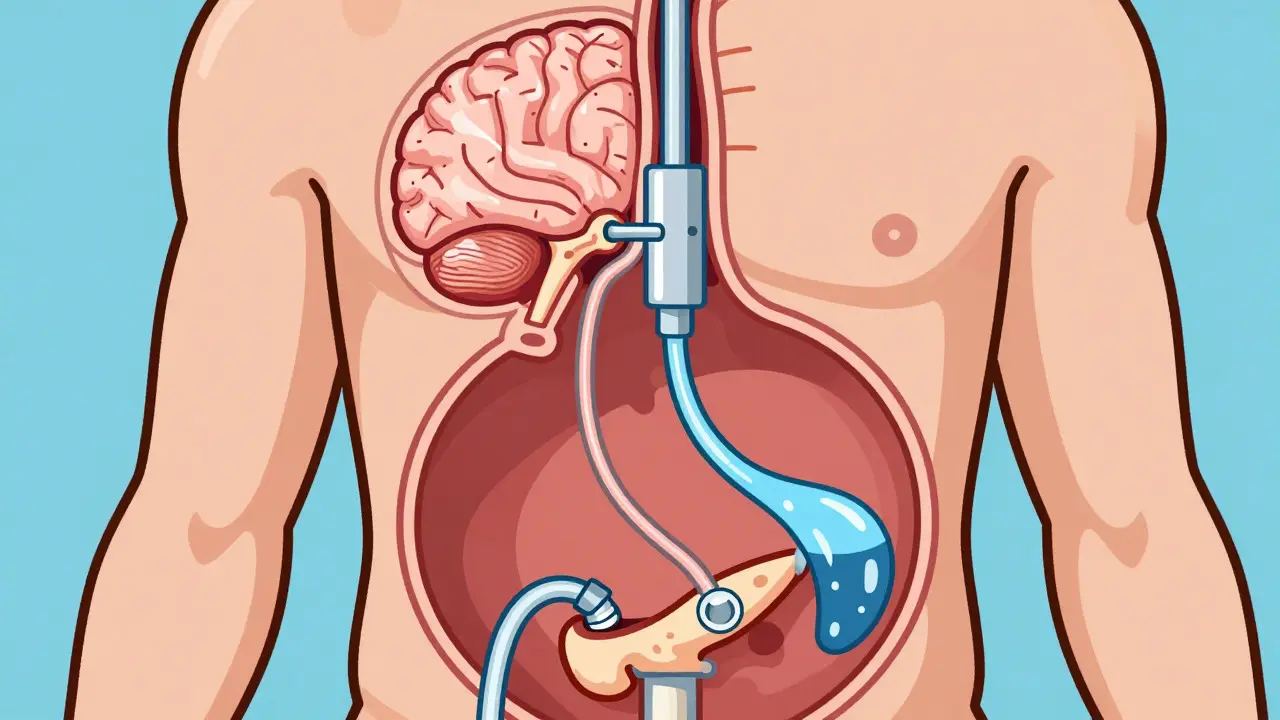
There is no medication for NPH. The only effective treatment is surgery to install a ventriculoperitoneal (VP) shunt. This device drains excess CSF from the brain to the abdominal cavity, where the body absorbs it.
| Metric | Shunt Surgery Success Rate | Alzheimer's Medication Improvement |
|---|---|---|
| Gait Improvement | 76% | Minimal |
| Cognitive Improvement | 62% | 35% |
| Urinary Control | 58% | None |
| Reversibility | Potentially Reversible | Progressive Decline |
Shunt systems include catheters and a pressure-regulated valve. Major manufacturers include Medtronic (Strata® valve), Codman (Hakim® valve), and Miethke. The procedure takes 60-90 minutes under general anesthesia. Hospital stays average 3.5 days, with full recovery taking 6-12 weeks.
While 70-90% of appropriately selected patients see improvement, risks exist. Complications include infection (8.5%), shunt malfunction (15.3% within two years), and subdural hematoma (5.7%). Regular follow-ups are essential to adjust valve pressures and monitor function.
NPH vs. Other Dementias: Key Differences
Understanding how NPH differs from Alzheimer's and Parkinson's helps in seeking the right care.
- Alzheimer's Disease: Memory loss is the primary early symptom. Gait issues appear late. Brain imaging shows shrinkage (atrophy), not enlarged ventricles. It is currently irreversible.
- Parkinson's Disease: Characterized by resting tremors and stiffness. Gait is shuffling but not "magnetic." Cognitive decline happens later. MRI does not show significant ventricular enlargement.
- Vascular Dementia: Symptoms worsen in steps after small strokes. Imaging shows multiple infarcts. NPH progression is gradual and smooth.
A 2022 study found MRI can differentiate NPH from Alzheimer's with 87% accuracy by looking at periventricular hyperintensities. If gait problems come before severe memory loss, think NPH.
Living with NPH: Patient Experiences and Outlook
Patients who undergo successful shunt surgery report dramatic changes. One 72-year-old man reduced his 10-meter walk time from 28 seconds to 12 seconds within 48 hours post-surgery. Many regain bladder control and mental clarity.
However, the journey isn't always smooth. Diagnostic delays average 14.3 months. Some patients face insurance hurdles, with 37% reporting prior authorization denials for diagnostic tests. Post-surgery, 32% require at least one shunt revision due to blockages or infections.
Despite challenges, 89% of surveyed patients express satisfaction with treatment. The key is finding a specialist familiar with CSF dynamics. Look for centers following International iNPH Guidelines.
When to See a Doctor
If you or a loved one are over 60 and experiencing:
- New difficulty walking or frequent falls
- Sudden confusion or slowed thinking
- Loss of bladder control without urinary tract infection
Request a referral to a neurologist or neurosurgeon specializing in hydrocephalus. Ask specifically about NPH and whether a CSF tap test is appropriate. Early intervention can mean the difference between remaining independent and needing long-term care.
Is Normal Pressure Hydrocephalus hereditary?
Most cases of NPH are idiopathic, meaning there is no known genetic cause. Secondary NPH results from head trauma, meningitis, or hemorrhage. While rare familial clusters exist, it is not considered a strongly inherited condition.
How long does a VP shunt last?
On average, a shunt lasts about 6.3 years before requiring revision. Factors like infection, blockage, or growth (in children) can shorten lifespan. Adults may need multiple revisions over their lifetime.
Can NPH be cured without surgery?
No. Medications cannot reverse the physical enlargement of ventricles or remove excess CSF effectively. Surgical shunting is the only proven treatment to halt and potentially reverse symptoms.
What is the cost of NPH shunt surgery?
In the U.S., Medicare covers approximately 85% of procedures, with average reimbursement around $28,450. Out-of-pocket costs vary by insurance. Shunt devices themselves cost between $3,200 and $5,800.
Who is at highest risk for NPH?
Adults over 60 are at highest risk. Incidence increases sharply after age 65. People with a history of head injury, meningitis, or subarachnoid hemorrhage are also at higher risk for secondary NPH.
