
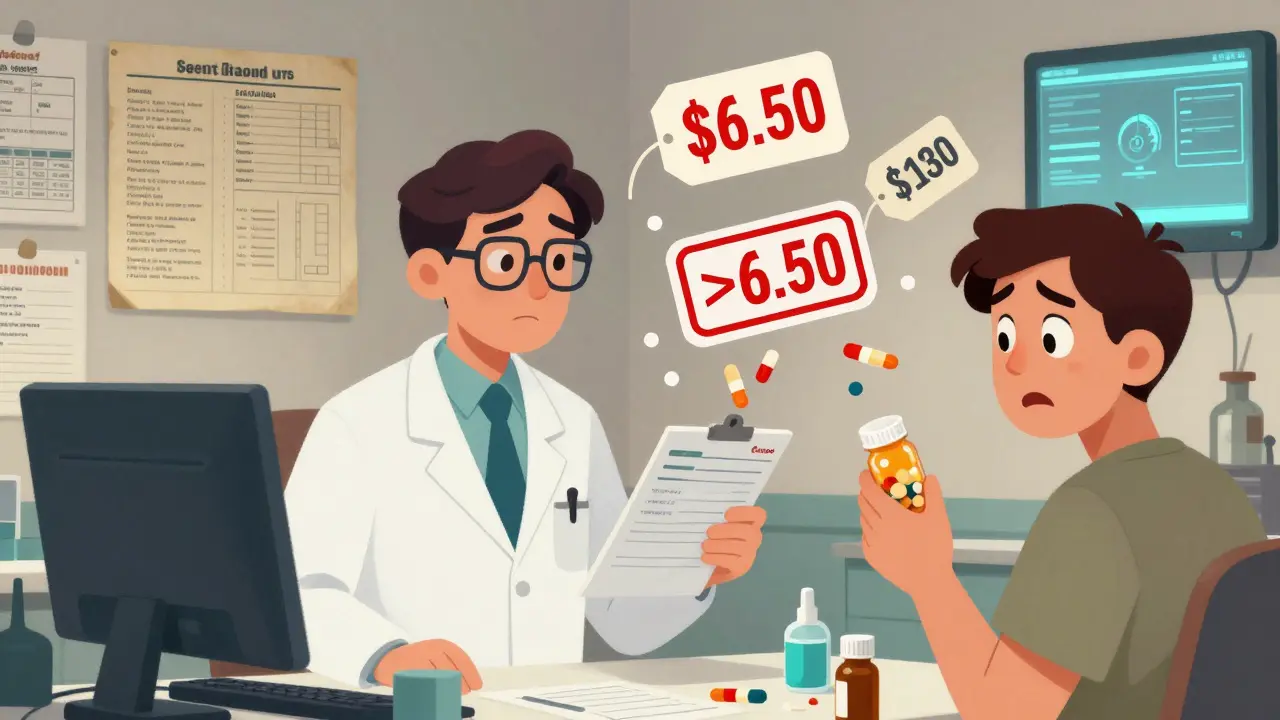
How much does a prescription really cost? For many doctors, nurses, and pharmacists, the answer isn’t as clear as you’d think. Despite prescribing medications every day, a growing body of research shows that clinicians frequently get drug prices wrong - sometimes by a lot. And when they’re wrong, it’s not just a numbers game. It affects whether patients can afford their meds, stick to their treatment plans, or skip doses because the cost is too high.
Doctors Guess Wrong - A Lot
A 2007 review of 29 studies found that physicians consistently misjudged drug prices. They overestimated the cost of cheap generic drugs by 31% and underestimated expensive brand-name drugs by 74%. That’s not a small mistake. It means a doctor might think a $5 pill costs $6.50 and assume a $500 drug is only $130. The data didn’t lie: only 31% of doctors correctly estimated the cost of low-priced medications, while 74% got high-cost drugs right. That gap isn’t random. It’s a pattern.Why does this happen? For one, most clinicians never see the actual price before writing a prescription. The pharmacy counter is where the price hits - not the exam room. In 2016, a study of 254 medical students and doctors found that only 5.4% of generic drug costs and 13.7% of brand-name drug costs were estimated within 25% of the real price. Even more startling: only 30% of dispensing costs were correctly guessed. Most clinicians had no idea what their patients would actually pay.
Students Know Less - But Get Better With Time
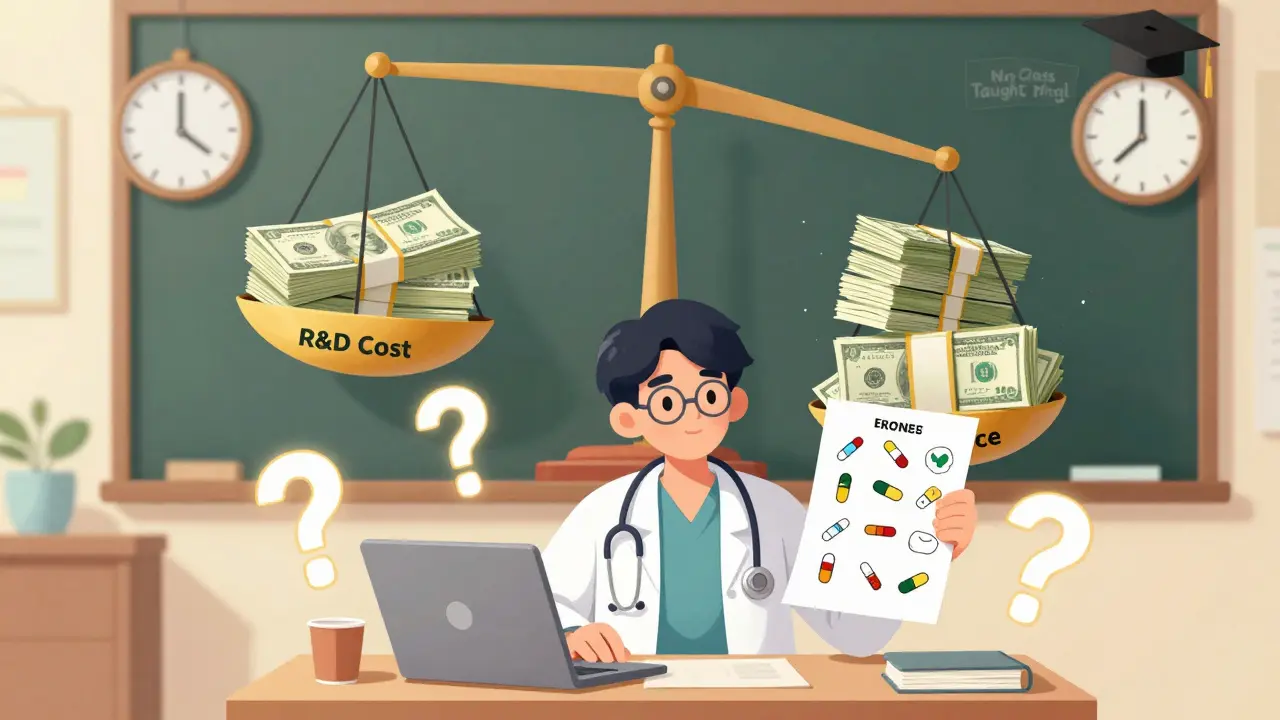
Medical students fare even worse. One study showed that on a 10-question quiz about drug pricing, the median score was just 6 out of 10. That’s barely passing. But here’s the hopeful part: as students progress through training, their knowledge improves. By the time they’re in their final years, they’re better at estimating prices than first-years. Still, even senior students don’t get it right most of the time.And here’s a shocking stat: fewer than half of medical students understand that drug prices have almost nothing to do with research and development costs. Most people - including clinicians - assume expensive drugs cost more because they took longer or cost more to develop. But that’s not how it works. A drug that costs $100,000 a year may have been developed for $20 million. Another that costs $5 may have cost $500 million to create. The price isn’t tied to R&D. It’s tied to patents, market control, and insurance negotiations. Yet few clinicians are taught this.
Electronic Health Records Are Changing the Game
The biggest shift in recent years? Real-time cost data in electronic health records (EHRs). A 2021 JAMA Network Open study showed that when doctors saw out-of-pocket costs directly in their EHR while prescribing, their accuracy jumped. Not just a little - dramatically. One in eight doctors changed a prescription after seeing a cost alert. That number rose to one in six when the potential savings were over $20.At UCHealth, doctors using a real-time benefit tool (RTBT) modified 12.5% of prescriptions based on cost alerts. That might sound low, but it adds up. Multiply that by thousands of prescriptions a week, and you’re talking about millions in savings for patients. But it’s not perfect. One resident on Reddit complained that their system showed insurer pricing but not the patient’s actual copay. So the alert said “$45,” but the patient ended up paying $180 because of their deductible. That kind of mismatch breeds distrust.
Who’s Getting It Right?
Age matters. Doctors under 40 are 26% more likely to use cost tools than those over 55. Why? They grew up with digital tools. They’re more comfortable clicking, checking, and adjusting based on data. They also have less attachment to old prescribing habits. Meanwhile, older physicians - even those with decades of experience - often stick to brand names because they don’t know the alternatives.Training matters too. Mayo Clinic’s Drug Cost Resource Guide, updated quarterly since 2019, has a 4.7/5 rating from 1,200 users. Compare that to the generic Medicare Part D formulary, which scores a 2.8/5. The difference? One is designed for real-time use. The other is a static list you have to look up separately. The right tool makes all the difference.
The Bigger Picture: Why It Matters
In 2022, U.S. spending on prescription drugs hit $621 billion. That’s 9.2% of all healthcare spending. And 28% of adults say they’ve skipped, cut, or delayed medication because of cost. That’s not just a statistic - it’s someone’s health on the line.When a doctor prescribes a $400 monthly drug when a $25 generic works just as well, they’re not just overpaying. They’re setting a patient up for failure. Non-adherence leads to ER visits, hospitalizations, and long-term complications. That’s more expensive than the drug itself. And it’s preventable.
Policy is catching up. The 2022 Inflation Reduction Act let Medicare negotiate prices for the first time. Eighty percent of Americans support it - Democrats and Republicans alike. The 2023 CMS rule now requires drugmakers to report out-of-pocket costs. That’s a big deal. It means pricing transparency isn’t optional anymore.
Where We’re Still Falling Short
Here’s the hard truth: 56% of U.S. medical schools still don’t teach drug pricing in their curriculum. No class. No module. No case study. Students graduate knowing how to treat hypertension - but not how much it costs to treat it.And pricing is still a mess. The same drug can cost $15 at one pharmacy and $320 at another. Insurance plans, pharmacy networks, and patient deductibles create a labyrinth. Even with EHR alerts, clinicians are often flying blind. A 2024 report found that five major drugs saw price hikes without any clinical justification. Humira, for example, went up 4.7% even though nothing changed about how it works.
What Needs to Change
It’s not enough to give doctors cost data. They need to understand it. They need training. They need to see how pricing affects outcomes. And they need systems that work reliably.Here’s what’s working:
- Real-time cost alerts built into EHRs - not as a pop-up, but as a seamless part of prescribing.
- Comparative pricing tools that show alternatives - generic, biosimilar, or lower-tier brand.
- Education starting in med school - not as an elective, but as core curriculum.
- Fixing the data - cost alerts must reflect actual patient out-of-pocket costs, not insurer list prices.
One study found that when cost tools were used well, patients saved $187 per year on average. That’s not a small number. It’s enough to cover a month’s worth of insulin, or a dozen asthma inhalers, or a year’s supply of blood pressure meds.
Doctors don’t want to be cost-cutters. They want to be healers. But you can’t heal someone who can’t afford the medicine. Cost awareness isn’t about saving money for insurers. It’s about saving lives.
Do clinicians usually know the real price of prescription drugs?
No, most don’t. Studies show that physicians overestimate the cost of cheap generic drugs by 31% and underestimate expensive brand-name drugs by 74%. Only about 30% of dispensing costs are estimated accurately. Even experienced doctors often guess wrong because they rarely see real-time pricing before prescribing.
How do electronic health records (EHRs) help with drug cost awareness?
EHRs with integrated cost alerts significantly improve accuracy. A 2021 study found that doctors with access to out-of-pocket cost data during prescribing were far more likely to choose lower-cost alternatives. One in eight changed a prescription after seeing a cost alert, and the rate jumped to one in six when savings exceeded $20. These tools reduce patient costs and improve adherence.
Why do doctors prescribe expensive drugs when cheaper ones exist?
Often, they simply don’t know the cheaper option is just as effective. Many are unaware of generic equivalents, biosimilars, or tiered formulary options. Others rely on habit, marketing, or incomplete training. Without real-time cost data, they default to what’s familiar - even if it’s more expensive.
Is drug pricing taught in medical school?
No, not consistently. A 2021 study found that 56% of U.S. medical schools have no formal curriculum on drug pricing. Students graduate without understanding how patents, insurance networks, or manufacturer pricing strategies affect what patients pay. This gap leaves clinicians unprepared to make cost-conscious decisions.
What’s being done to fix this problem?
Several efforts are underway. The 2022 Inflation Reduction Act allows Medicare to negotiate drug prices. The 2023 CMS rule requires manufacturers to report out-of-pocket costs. Hospitals like UCHealth and Mayo Clinic have implemented real-time cost tools with measurable success. Medical schools are slowly adding pricing modules. But adoption is still low - only 37% of U.S. health systems use real-time benefit tools as of late 2024.
Can cost awareness reduce patient non-adherence?
Yes. When clinicians choose lower-cost alternatives based on accurate pricing data, patients are more likely to fill and stick with their prescriptions. One study found cost-aware prescribing reduced patient out-of-pocket expenses by $187 annually per person - enough to prevent skipping doses or going without medication.


So let me get this straight - doctors are basically guessing drug prices like it’s a game of Twenty Questions while their patients are out here choosing between insulin and groceries. 🤦♂️ And we wonder why people skip meds? It’s not laziness. It’s a system designed to make you suffer in silence. I’ve seen it firsthand. My grandma took half her pills because the copay was $120. She didn’t know it was a $12 generic. The doctor didn’t know either. This isn’t medical malpractice - it’s bureaucratic negligence.